The honeymoon phase with a payment processor is intoxicating. You sign up, copy and paste a snippet of code, and suddenly your website is accepting credit cards from halfway across the globe. For many businesses, Stripe feels like a miracle in the early days. It is sleek, it is fast, and it works without requiring you to understand a single thing about interchange fees or merchant category codes.
However, eventually, the honeymoon ends. Transaction volumes swell, your business model gets complex, and you start seeing the friction that was invisible when you were processing your first thousand dollars. As your business matures, you need to start looking for more sustainable options.
Many businesses opt for Stripe because its easy setup. It’s a well-known and straightforward choice. However, as transaction volumes increase, some businesses face challenges that were not apparent at the start. Payment processing requirements often evolve as companies grow.
This guide compares ECS Payments and Stripe across pricing, support, risk management, integrations, and long-term business value to help you decide if it is time to look for a Stripe alternative.
What ECS Payments Offers
ECS Payments functions as a full-service partner. They provide individual merchant accounts, which gives you a direct connection to the banking network rather than sharing an account with thousands of other businesses.
You also get integrated payment solutions, dedicated customer support that actually answers the phone, and deep, industry-specific payment expertise. It is a consultative approach rather than a self-service one.
What Stripe Offers
With 1.5 million businesses using Stripe, it’s no wonder there is a debate. There are qualities Stripe processes that cn benefits busineeeses. But there are certainly areas where stripe isn’t the overall winner for others.
Stripe is a developer-focused payment platform. Its primary value proposition is its API. If you have an engineering team that wants to build a custom checkout experience, Stripe provides the toolbox. It relies on self-service onboarding. You are largely on your own to navigate the dashboard, set up your dispute logic, and manage your account settings.
Pricing and Processing Costs
Pricing is usually the first place businesses look when they decide on their payment provider.
Stripe’s Flat-Rate Pricing Model
Stripe’s simplicity is its greatest strength. They charge a flat rate for every transaction. It is predictable, and it is easy to forecast. For a new business, this clarity is invaluable.
Here is the problem. Flat-rate pricing includes a premium for the convenience of not having to think about your processing rates. As your transaction volume grows, that premium becomes a massive, unnecessary expense.
If you have a high average ticket size, you are likely overpaying. The margin Stripe takes is often significantly higher than what you would pay with a wholesale pricing model. B2B payment acceptance is a prime example where flat-rate pricing can cannibalize your profit margins. You are paying retail prices for wholesale activity.
ECS Payments and Customized Pricing
ECS Payments moves away from the one-size-fits-all model. They focus on tailored pricing models. By moving to an interchange-plus structure, you are paying exactly what the banks charge plus a transparent markup
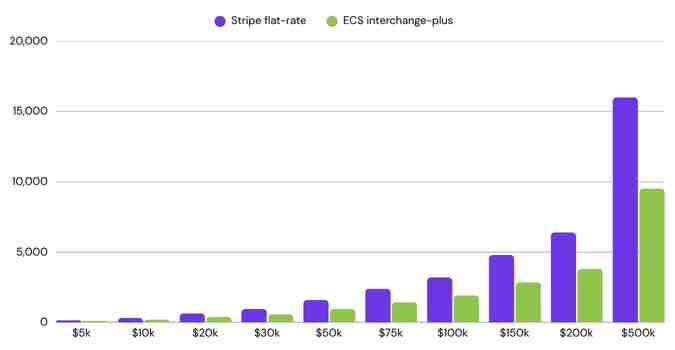
As your business grows, this model usually offers significant cost savings. It is the difference between buying a suit off the rack and getting one tailored to your specific measurements. But if flat-rate works best for your business model, ECS Payments offers this structure as well.
Customer Support: Dedicated Experts vs Self-Service Support
If you have ever been in the middle of a massive sale or a critical B2B transfer only to have your payments blocked, you know that the quality of your support team is the difference between a minor hiccup and a business crisis.
One of the Most Common Stripe Complaints: Limited Access to Live Support
Stripe is a tech company, and they act like one. When you have a problem, you are usually ushered into a ticket queue. You might get a chatbot, a help center article, or an email response from a generalist.
For many businesses, reaching a dedicated representative is near impossible. When payment disruptions occur, you are left waiting for an email reply while your revenue stream sits frozen.
When payments stop, everything else stops. You lose revenue, your customers get frustrated, and your internal operations grind to a halt. When it comes to your transactions, silence is dangerous. You need someone who can look at your account and solve issues in real-time.
ECS Payments’ Personalized Support Model
ECS Payments prioritizes human interaction. You get dedicated account assistance. Calls do not go into a general queue. A payment specialist is available by phone in a few seconds. Any questions get answered immediately. Emails to our merchant services team are responded to within the hour. And if there is a concern that needs to be explored more, you will be updated along the way.
Account Stability and Risk Management
This is the hidden variable that ruins many companies. People rarely think about their merchant account status until it gets flagged.
Understanding Stripe’s Aggregated Processing Model
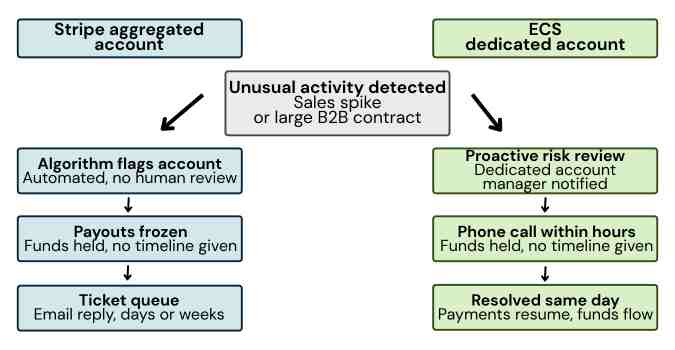
Stripe uses an aggregated model. You are not opening a merchant account in your own name; you are sub-processing under Stripe’s master merchant account. They do this to make onboarding fast. The tradeoff is that their risk monitoring is automated and often aggressive. If their algorithm detects a pattern that looks suspicious, or even just different, they can pause your payouts instantly.
Because Stripe’s system is automated, it lacks nuance. If your sales suddenly spike because of a viral marketing campaign, or if you sign a massive new B2B contract, the system might trigger a risk review. You get a notice that your funds are on hold. It is a jarring, disorienting experience. Your operational impact is severe when you cannot access your own money.
ECS Payments and Dedicated Merchant Accounts
ECS Payments provides dedicated merchant accounts. Because you are underwritten as an individual entity, the relationship is more transparent. The risk management is proactive, not reactive. You are not sharing a risk profile with thousands of other random businesses. This structure leads to much more predictable payment operations.
Fund Availability and Deposit Timing
Cash flow is the lifeblood of any growing enterprise. The speed at which your money moves from the processor to your bank account is critical.
How Stripe Handles Funding
Stripe’s funding schedules are standard and generally work well for most small businesses. However, a major issue arises when Stripe reviews an account. Once a flag is raised, Stripe often halts a merchant’s payouts completely.
This can leave businesses waiting for weeks during the investigation, with no clear timeline for resolution. This can be a critical problem for companies operating on tight margins or those that rely on fast cash flow.
ECS Payments’ Approach to Funding Transparency
ECS Payments operates with a focus on clear funding expectations. They understand that business owners need to plan their cash flow. There is communication throughout the payment lifecycle, meaning you are never left guessing when your funds will arrive. Which is generally 1 business day.
Integration Capabilities
Integration is where the conversation gets technical, but it is also where the “Stripe alternative” discussion often centers.
Stripe’s Strength in Developer Customization
If you are building a custom checkout flow from scratch, Stripe is difficult to beat. Their API is developer-friendly, well-documented, and incredibly flexible. For startups, this is usually why they start with Stripe in the first place.
While Stripe is arguably the easiest platform to launch with, that ‘plug and play’ advantage changes as your needs evolve. It is perfect for simple, web-based transactions. But as soon as you need to automate deep integrations with non-web business software like ERPs or complex accounting platforms, you often move from ‘plug and play’ into ‘custom development.’ If you don’t have an in-house developer to maintain those API connections, that maintenance can become a hidden operational cost.
ECS Payments and Business Software Integrations
ECS Payments excels at bridging the gap between your payment processing and your operational software. They offer robust integrations with common ERP systems, accounting platforms, and CRM tools. It is about making your payment data talk to your accounting data without requiring a custom API build.
Chargebacks and Dispute Management
Disputes are a cost of doing business. In fact, 64% of merchants have reported an increase in friendly fraud. It’s how you handle chargebacks that will change your bottom line.
Managing Chargebacks With Stripe
Stripe provides a dashboard for disputes. It is functional, but it is largely self-service. You upload your evidence, you cross your fingers, and you hope the issuer rules in your favor.
Businesses often manage these disputes internally, taking valuable time away from revenue-generating activities. There is very little hand-holding. If you lose a dispute, you are rarely told why or how you could have prevented it next time.
ECS Payments and Hands-On Chargeback Support
ECS Payments provides actual assistance. They offer guidance on best practices for reducing chargebacks, and they help you organize your documentation. They send in your receipts and dispute documentation for you.
Scalability for Growing Businesses
Every business reaches a point where its initial infrastructure no longer supports its ambitions.
When Stripe Makes Sense
Stripe is the king of the start-up phase. If you are a lean team, a developer-led organization, or a venture-backed startup that needs to launch an MVP in a weekend, Stripe is the right choice.
You outgrow Stripe when the complexity of payment processing becomes overwhelming. As your transaction volume increases, you will need lower processing costs. When managing multiple locations, complex inventory, or B2B payment requirements, better support becomes essential. Eventually, you may become frustrated with the lack of transparency, automated holds, and the absence of a human representative to assist you.
ECS Payments for Long-Term Growth
ECS Payments is designed for the long haul. But they also are great for new small businesses. ECS serves a variety of merchant sizes across most industries. They provide a customized payment infrastructure that grows with you. By moving to a dedicated account model, you remove the artificial ceilings that aggregators impose on your growth.
Hear from our Referral Partner Manager, Abe Berg, on how ECS Payments treats merchants like true partners, not just account numbers.
At ECS Payments, we believe every business deserves support that is personal, transparent, and built around their goals. From payment solutions to ongoing service, our team works alongside merchants to help them grow with confidence.
Industry-Specific Payment Needs
Different businesses need different tools.
- B2B Companies: These businesses need invoice payments and ERP integrations. ECS Payments helps with Level 2 and Level 3 processing, which can lower your interchange rates significantly.
- Healthcare Organizations: They need secure, HIPAA-compliant payment collection. This is not a place for standard retail plugins.
- Field Service Businesses: They need mobile payments and seamless customer invoicing that happens on the job site.
- Nonprofits: They need specialized support for donation processing and ACH payment support.
Why Businesses Choose ECS Payments Over Stripe
If you are evaluating ECS Payments vs Stripe, look at what you want your business to look like in three years. Do you want to be troubleshooting payment tickets, or do you want a dedicated merchant account that supports your growth?
- Dedicated Merchant Accounts: You get your own identity with the bank.
- Personalized Customer Support: You have a person, not a ticket number.
- Customized Pricing Models: You pay wholesale rates, not retail markups and can choose the structure that suits you best.
- Business Software Integration Expertise: You connect your payments to the tools you already use.
- Long-Term Partnership Approach: You work with a provider that is invested in your success.
Final Thoughts
Stripe will always be a dominant force for businesses seeking quick deployment and developer flexibility. It solved a massive problem for the early internet generation. However, as businesses grow, support, pricing, and account stability often become more important than the speed of onboarding.
ECS Payments provides the dedicated merchant accounts, personalized support, and scalable payment solutions required for long-term growth.
The best choice depends entirely on your business model, your transaction volume, and how much operational control you want to maintain. If you are tired of the automated walls, it might be time to find a partner who picks up the phone.
