News flash! It’s not difficult customers who refuse to pay that cause delays in your payments. It is most likely your sales and transaction processes that delay your cash flow. You may close a deal, agree on the details of the arrangement, and presume everyone is walking away assuming the next step is obvious.
You send the invoice later. There is no easily accessible payment link. There is no reminder to follow up when your customer lags in payments. Communication gets lost, jumbled, and eventually awkward. Payment is now weeks behind.
CRM payment integration exists to remove these quite gaps that slow down how your business gets paid. Integrated CMRs tighten the existing connection between your sales process and your revenue. Let’s dig deeper.
What Is CRM Payment Integration?
CRM payment integration is exactly what it sounds like. It connects your customer relationship management system with your payment processing capabilities, so everything happens in one place.
Instead of managing customer data in one system and payments in another, both live inside your CRM. That means when you pull up a customer record, you are not just seeing contact information or notes from your sales team. You are also seeing invoices, payment history, and stored payment methods.
This kind of setup changes how decisions get made. You are no longer piecing together information from different platforms. You are working from a single, consistent view of your customer and their financial activity.
How To Integrate Payments Into CRM
The functionality itself is not complicated. What makes it powerful is where it lives. Payment tools are embedded directly into your CRM. Your team can send invoices, collect payments, and manage billing without ever leaving the system they are already using.
When a customer makes a payment, that information is automatically tied to their profile. There is no manual entry. No reconciliation across multiple systems or guessing whether a payment has cleared. With integration ties to automation, finance departments can reduce costs by almost 30%.
The transaction flow within a CRM keeps every team updated in real time. Once a customer initiates a payment in the CRM, the payment provider processes it securely, records it back into the system in real time, and then provides feedback loops that keep everything aligned for your sales, finance, and operations teams.
Key Features of CRM Payment Integration
Once payments are built into your CRM, a few key capabilities tend to stand out. Embedded payment forms allow you to send customers a secure way to pay directly from an invoice or email. There is no need to redirect them somewhere else.
- Secure Storage: Customer profiles can securely store their chosen payment methods. This helps to enable faster repeat transactions and support recurring billing.
- Automation: Automated invoicing reduces the need for manual follow-ups. You can schedule invoices, send reminders, and collect payments without having to chase them down.
- Real-time reporting: Real-time reporting gives you visibility into what has been paid, what is outstanding, and how your revenue is trending.
- Tokenization: Security is handled through tokenization and compliance standards that protect sensitive payment data. The PCI Security Standards Council outlines how businesses should manage this responsibility, particularly when handling cardholder data.
ECS Payments helps you create a smoother customer experience with integrated payment solutions built directly into your CRM.
Benefits Of CRM Payment Integration
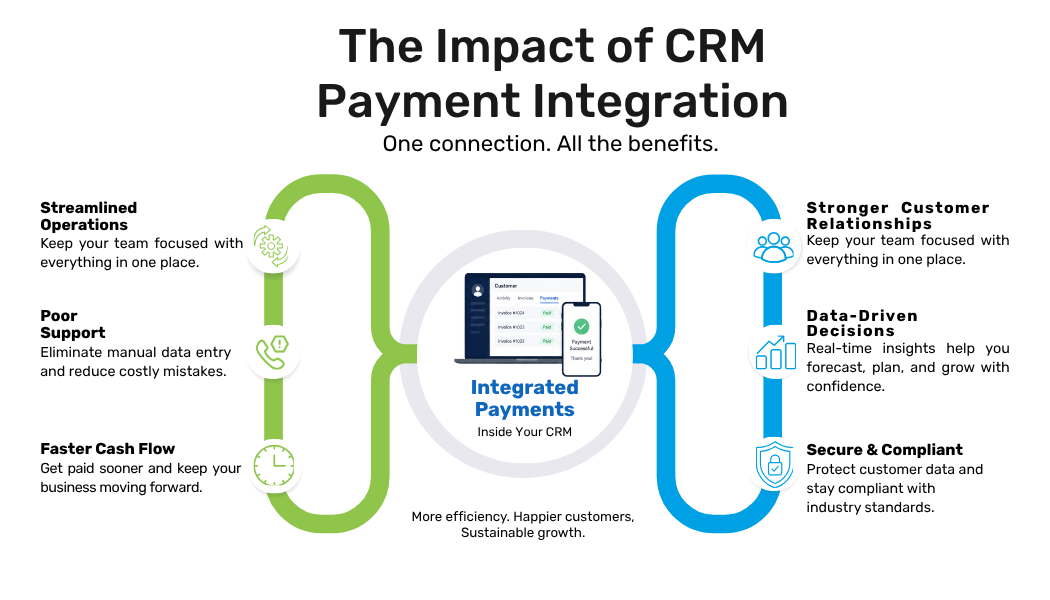
There are many benefits to integrating CRM payments into your business. It optimizes both your high-level strategy and your daily tasks.
Smoother Workflow
First, workflows become simpler. Your team is not bouncing between systems or manually updating records. Everything happens in one place.
Less Manual Work and Fewer Errors
Second, you reduce manual data entry. That alone reduces errors, which can escalate into billing disputes or accounting issues if left unchecked.
Faster Payment Collection
Third, your payments come in faster. Not only that, they can also increase sales. Businesses that utilize CRM software can raise its sales by 29%. The fewer barriers to your customers paying, the better. CRMs can send a payment link or a direct invoice. Businesses that offer more streamlined payment options tend to see faster payment cycles.
Improved Customer Experience
Next, you will see a noticeable improvement in your customer experience. With integrated CRMs, clients won’t have to navigate multiple systems just to complete their transaction. In fact, 61% of consumers agree that ease of use and convenience are the most-desirable qualities in payments. When the whole process is more organized, the result is a direct positive reflection on your business as a whole.
Better Visibility into Revenue
Lastly, CRM integration helps you gain better visibility into your customer activity and revenue. You can easily see who has paid, who has not, and where things stand without having to dig through multiple platforms.
Who Should Use CRM Payment Integration
Not every business operates the same way, but there are clear use cases where this type of integration makes a significant difference.
- B2B companies that rely on invoicing and long-term relationships benefit from having everything tied to the customer lifecycle.
- Service businesses can simplify their billing and reduce administrative work by handling payments directly in their CRM.
- Sales-driven organizations gain speed. When a deal closes, payment can follow immediately without additional steps.
- Businesses that operate with recurring billing models can automate their payment schedules, reducing the need for manual oversight.
If your business depends on structured sales and consistent cash flow, this is worth serious consideration.
Common Challenges With CRM Integration and How to Avoid Them
Like any system upgrade, there are a few areas where businesses tend to run into trouble.
Compatibility
Compatibility issues can come up depending on your CRM. Before moving forward, confirm that your platform supports the level of integration you need.
Integration
Integration can feel complex at the start, especially if your CRM was not originally designed with payments in mind. Having the benefits of a CRM with payment processing is where choosing the right payment partner matters. Some providers are built to work within existing CRM environments, which simplifies the process.
Inconsistencies
Data inconsistencies are a major risk and an all-too-common symptom when customer relationship management (CRM) systems and payment processors are only partially or poorly connected.
The core objective of integrating a CRM and a payment gateway is full synchronization. This means that any update in one system such as a new payment, a refund, a failed transaction, or an updated customer address, is instantly and accurately reflected in the other. Anything less than full synchronization will inevitably result in the very inconsistencies the integration was meant to prevent.
Security
With any business that handles sensitive information, security is perhaps the most critical concern. It comes with a profound responsibility. Shortcuts or compromises are non-negotiable.
Failure to maintain compliance can result in catastrophic data breaches, significant fines from card brands, legal action, the revocation of your ability to process credit card payments, and irreversible damage to customer trust and brand reputation.
It is absolutely essential to work with a payment processor and an integration method that strictly adheres to the Payment Card Industry Data Security Standard (PCI DSS). Your processor and payment gateway should demonstrate robust security measures, including:
- data encryption
- tokenization (replacing sensitive data with a non-sensitive equivalent)
- secure network architecture
- regular security audits
- and ensuring sensitive cardholder data never touches your CRM servers but is instead handled directly by the PCI-compliant payment gateway.
How CRM Payment Integration Supports Cost Efficiency
Cost efficiency may build gradually. Administrative workload begins to shrink as automation takes over routine tasks. Your team operates more efficiently because they spend less time on repetitive tasks.
Errors become less common, which reduces both direct and indirect costs. Small mistakes have a way of adding up, especially when they involve financial data.
Operational efficiency improves because your systems support your workflow instead of slowing it down. And perhaps most importantly, payment cycles shorten, giving you faster access to revenue.
Key Considerations When Choosing a CRM Payment Solution
Not all solutions are created equal, so it is worth taking a closer look before making a decision.
- Compatibility with your CRM: The solution should work naturally within your CRM, not force a change in operations.
- Ease of implementation: A straightforward setup is essential. It ensures quick adoption and minimizes frustration from your team.
- Payment method support: Ensure the flexibility to accept various methods like cards, ACH, and others, based on customer preference.
- Reporting capabilities: Look for clear insights into transactions and customer behavior.
- Security and compliance: The solution must meet all necessary industry standards.
CRM Payment Integration vs Standalone Payment Systems
Standalone payment systems still serve a purpose, particularly for businesses with simple transaction models.
As operations grow, the separation between systems becomes more noticeable. If you have ever had to reconcile payments from one system with customer data in another, you already understand the difference.
Standalone systems create obvious separation. Payments happen in one place, customer management happens in another, and someone has to connect the dots. It becomes cumbersome and frustrating. Behold! There is a better way.
Integrated systems bridge gaps. They foster seamless connections and collaboration between your systems. This not only simplifies workflows by minimizing steps but also enhances accuracy. While standalone systems can serve niche needs, integration is usually the more efficient choice for growing businesses.
Best Practices for Implementation
Implementing a robust CRM payment integration is a strategic move, but it also calls for careful planning, and you should expect a learning curve. Adhering to several key best practices for a smooth integration can transform a potentially disruptive change into a powerful efficiency gain.
Align Workflows with Existing Sales Processes
Your payment workflows should match how your sales team already operates. (Only if it’s currently effective). Who knows, maybe this change will lead your sales team down a better path. But, if you already have a successful sales operation, then your CRM should simply enhance it, not force your team to contort their established routines to fit the software. The integration should feel like a natural extension of the existing sales cycle.
Staff Training
The best technology is useless if the team doesn’t know how to use it effectively. Training your team is important. If people do not understand how to use the system, they will find workarounds that defeat the purpose of the automated integration.
Training should be role-specific, covering the mechanics of processing a payment and also how the integration impacts their daily tasks, reporting, and compliance responsibilities.
Monitor Performance
With integration, you can’t just “set-it-and-forget-it.” Monitoring performance helps you identify what is working and what may need some fine tuning. Tracking your key performance indicators (KPIs)—payment processing time, error rates, customer abandonment during checkout—helps to provide actionable insights into bottlenecks, potential user experience issues, and areas that may require additional training.
Maintain Quality Data
The core value of your CRM is the quality of its data. Maintaining clean, consistent data ensures your CRM remains reliable over time. When payments are processed directly in the CRM, they automatically tie transaction details to the corresponding customer, opportunity, and sales record.
Where ECS Payments Fits Into the Picture
When businesses start looking into CRM payment integration, the conversation often turns to technology. But the provider behind that technology plays just as important a role.
Hear more from Tech Support Manager Sebastian Perry on how our team is always just a phone call or email away when you need support.
ECS Payments helps businesses bring payment processing directly into their existing systems without adding unnecessary complexities. The simpler the better, we get that. Our focus is to create integrated payment solutions that align with how companies already operate. That includes supporting CRM environments where payments, customer data, and reporting work together. We provide merchants with the flexibility to accept payments in their CRM systems, including card transactions, ACH, and other methods.
CRM payment processing implementation is an ongoing process, not a one-time setup. As businesses grow and their needs change, their payment infrastructure must adapt. For companies looking to automate payments in CRM systems and streamline their workflows, having a provider that understands both the technical and business sides can make a measurable difference.
Final Thoughts
CRM payment integration is not about adding another layer to your business. It is about removing the friction that has been there all along. When payments are built into your core systems, everything moves faster. Your team spends less time managing processes and more time focusing on growth. And as payment expectations continue to evolve, businesses that take a more integrated approach will be better positioned to keep up.
Next Steps
Take a look at how your current systems are set up. Where are payments slowing things down? How much time is being spent on manual tasks? Are your customer and payment data truly connected?
From there, start evaluating payment solutions for CRM systems that fit your workflow.
Ready to implement something new? Contact us at ECS Payments to see where we can streamline your payments.
