For many small businesses, operating as a cash-only business wasn’t a strategic decision; it was simply how things started.
Whether you’re running a neighborhood restaurant, retail store, food truck, service business, or contractor operation, cash has always offered a few obvious advantages. There are no payment processing fees, no waiting for deposits, and no technology to manage. Every dollar collected is immediately available.
For years, that model worked well.
Today’s marketplace looks very different.
Consumers increasingly expect to pay with credit cards, debit cards, digital wallets, and contactless payment methods. Many rarely carry enough cash to cover everyday purchases, and they often decide where to shop based on convenience as much as price.
The question isn’t simply whether accepting credit cards costs money. Every payment method has costs. The more important question is whether refusing card payments is costing your business far more in lost sales, reduced customer satisfaction, and missed opportunities for growth.
Why Many Businesses Stay Cash-Only
There are several legitimate reasons why business owners continue operating without card payments.
Avoiding Processing Fees
The biggest concern is usually processing costs.
Every credit card transaction includes fees that are shared among the card-issuing bank, the card network, and the payment processor. For businesses operating on narrow margins, those costs deserve careful consideration.
Cash transactions avoid these fees entirely.
Immediate Access to Funds
Cash is available immediately.
There are no settlement periods or deposit schedules to monitor. The money is in your register as soon as the transaction is complete, giving business owners immediate liquidity.
Operational Simplicity
Running a cash-only operation also requires less technology.
There’s no payment terminal to configure, no merchant account to establish, and fewer systems to maintain. For some businesses, especially those with simple operations, this can feel easier to manage.
Traditional Business Practices
Many family-owned businesses have accepted only cash for decades.
If the business has operated successfully for years without accepting cards, it’s understandable to question whether changing the payment process is necessary. The challenge is that customer behavior has changed dramatically, even if the business itself hasn’t.
How Consumer Payment Preferences Have Changed
The way people pay has evolved significantly over the past decade.
Customers Carry Less Cash
Many consumers no longer carry substantial amounts of cash. Instead, they rely on debit cards, credit cards, smartphones, and smartwatches for nearly every purchase.
For many younger consumers, especially, paying electronically has become second nature.
Contactless Payments Continue to Grow
Tap-to-pay technology has become commonplace.
Customers increasingly expect to complete transactions by tapping a card or using mobile wallets such as Apple Pay, Google Pay, or Samsung Wallet. These payment methods are quick, convenient, and familiar.
Convenience Influences Purchasing Decisions
Consumers value convenience.
If one business accepts its preferred payment method and another does not, the easier payment experience often wins. In many cases, the payment process has become part of the overall customer experience.
The Hidden Cost of Being Cash-Only
Processing fees are easy to calculate.
The cost of refusing electronic payments is much harder to measure, but it can be significantly greater.
Lost Sales Opportunities
Imagine a customer walks into your business planning to make a purchase. They reach the register, discover you only accept cash, and realize they don’t have enough with them.
Many won’t search for an ATM. Instead, they’ll simply leave.
Every one of those lost transactions represents revenue that never reaches your business.
Reduced Average Transaction Sizes
Consumers often spend more when paying with cards. Without being limited by the amount of cash in their wallet, customers may feel more comfortable purchasing additional items or upgrading their purchase.
Cash-only businesses may unintentionally limit average ticket sizes.
Missing Younger Customers
Younger generations have grown up using electronic payments. Many expect businesses to accept cards, mobile wallets, and contactless payments as a basic service.
A cash-only policy can introduce unnecessary friction before the sale is even completed.
Competitive Disadvantages
If nearby competitors accept multiple forms of payment while you only accept cash, customers naturally have more flexibility elsewhere.
Payment convenience can become a competitive advantage, even when products and pricing are similar.
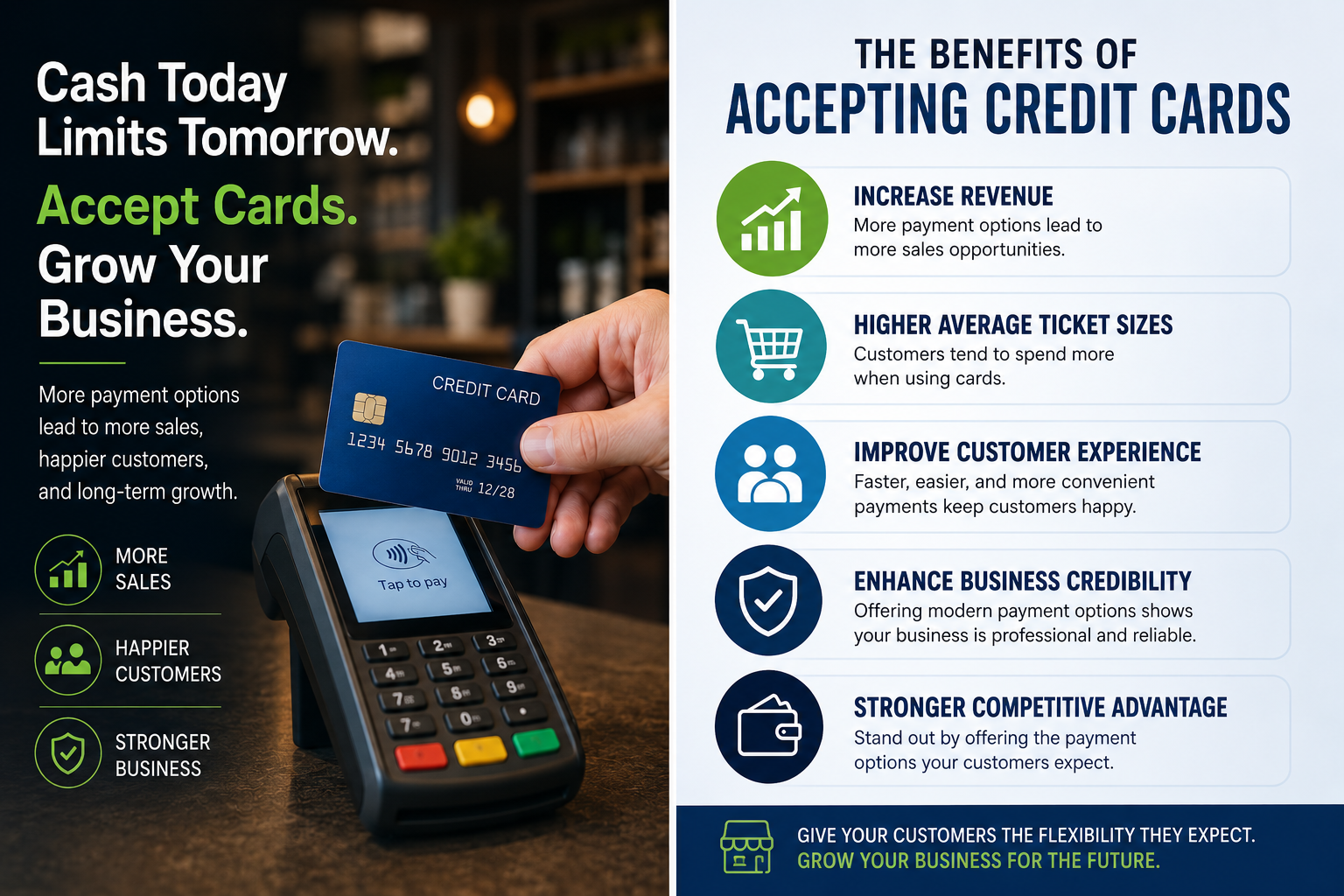
Benefits of Accepting Credit Cards
Accepting electronic payments isn’t simply about offering another way to pay. It can positively affect several areas of your business.
Increased Revenue Potential
Every additional payment option removes another obstacle to completing a sale. Customers can purchase what they want using the payment method they already have available.
Higher Average Ticket Sizes
When customers aren’t limited by the cash in their pockets, they’re often more willing to make larger purchases. That can translate into increased average transaction values over time.
Improved Customer Experience
Electronic payments offer a smoother checkout process.
Customers appreciate quick transactions, contactless payment options, and the flexibility to choose how they pay. A better checkout experience can encourage repeat business.
Enhanced Business Credibility
Modern payment acceptance often influences customer perception.
Businesses that accept multiple payment methods are frequently viewed as more established, professional, and customer-focused.
What Credit Card Processing Actually Costs
Processing fees are real, but understanding how they’re structured helps put them into perspective.
Understanding Processing Fees
Most credit card processing costs consist of three primary components:
- Interchange fees, which are established by the card networks and paid to issuing banks.
- Assessment fees, which are charged by the card networks themselves.
- Processor markups, which compensate the payment processor for providing payment services and support.
The exact cost varies based on the type of card used, the industry, and the processing agreement.
Looking Beyond the Percentage
Many business owners focus exclusively on the processing percentage. While fees matter, they represent only one side of the equation.
It’s equally important to evaluate:
- Additional sales that electronic payments may generate.
- Higher average transaction amounts.
- Improved customer retention.
- Operational efficiencies.
The overall impact on revenue often provides a more meaningful measurement than processing fees alone.
A Real-World Perspective
Imagine losing a $150 sale because a customer only has a credit card.
Even if processing that transaction would have cost a few dollars in fees, the alternative was earning nothing at all. Viewed this way, processing costs often become far easier to evaluate.
Industries Where Card Acceptance Delivers Significant Value
Nearly every industry benefits from electronic payments, but some experience particularly noticeable improvements.
Restaurants and Food Service
Fast, convenient payments help keep lines moving and improve customer satisfaction, particularly during busy service periods.
Retail Stores
Retail businesses often experience larger average purchases when customers aren’t limited by the cash they carry.
Service Businesses
Whether you’re a salon, repair company, consultant, or fitness studio, electronic payments simplify invoicing and make collecting payments easier.
Contractors and Home Services
Mobile payment solutions allow contractors, HVAC companies, electricians, plumbers, and landscapers to collect payment on-site, reducing delays and improving cash flow.

Common Concerns About Accepting Credit Cards
It’s natural to have reservations about changing the way your business accepts payments.
“The Fees Are Too High”
Rather than evaluating fees in isolation, compare them against potential increases in revenue, customer retention, and completed sales.
“Cash Is Simpler”
Modern payment solutions have become remarkably straightforward.
Many systems can be set up quickly and are designed for businesses without extensive technical experience.
“My Customers Prefer Cash”
Some certainly do.
However, customer expectations often change gradually. If customers are frequently asking whether you accept cards, they’re providing valuable feedback about evolving preferences.
“I Don’t Want Additional Complexity”
Today’s integrated payment solutions can actually simplify business operations by combining payment acceptance, reporting, receipts, and transaction history into a single platform.
Alternatives to Traditional Credit Card Processing
Accepting credit cards doesn’t mean abandoning cash.
Many businesses choose a combination of payment options.
Debit Card Acceptance
Debit cards provide customers with another convenient payment method while supporting quick transactions.
ACH Payments
For larger invoices or recurring payments, ACH transfers may offer a lower-cost electronic payment option than traditional card payments.
Mobile Payment Solutions
Tap-to-pay technology and digital wallets continue to gain popularity among consumers looking for fast, secure transactions.
Hybrid Payment Strategies
Many successful businesses simply give customers a choice.
Accepting cash alongside electronic payments offers flexibility while preserving the benefits of both.
Questions Every Cash-Only Business Should Ask
If you’re considering whether to begin accepting cards, ask yourself:
How Many Sales Are Being Lost Today?
Even a handful of lost transactions each week can add up over the course of a year.
How Often Do Customers Ask About Card Payments?
Customer questions often reveal changing expectations before sales data does.
Are Competitors Accepting Electronic Payments?
Understanding your local competitive landscape can help determine whether payment flexibility has become an advantage.
Would Faster Payment Collection Improve Cash Flow?
Electronic payments can simplify invoicing and reduce the time spent collecting outstanding balances.
Could Additional Convenience Increase Revenue?
Removing barriers during checkout often makes it easier for customers to complete purchases.
Signs It May Be Time to Accept Credit Cards
Your business may benefit from electronic payments if you’re experiencing any of the following:
Growing Customer Demand
More customers are asking whether you accept cards or digital wallets.
Increasing Competition
Nearby businesses are offering multiple payment methods while maintaining competitive pricing.
Expanding Business Operations
As businesses grow, payment flexibility often becomes increasingly important.
Larger Average Transaction Values
Higher-value purchases become easier when customers aren’t limited by the cash they have available.
Improving the Customer Experience
Convenient payment options can contribute to a smoother overall buying experience.
How ECS Payments Helps Businesses Transition From Cash-Only Operations
Making the move from cash-only to electronic payments doesn’t have to be complicated.
Easy Payment Acceptance
ECS Payments helps businesses implement payment solutions that fit their operations, whether they sell in-store, online, on the road, or at customer locations.
Credit Card and Debit Card Processing
Accept major credit cards and debit cards through secure, reliable payment technology designed for businesses of all sizes.
Mobile and Contactless Payment Options
Offer customers the flexibility to pay using tap-to-pay cards, digital wallets, and mobile payment solutions.
Transparent Pricing
Understanding your payment processing costs is important. ECS Payments works with businesses to provide clear pricing and help identify solutions that align with their operational needs.
Dedicated Customer Support
From setup through ongoing service, ECS Payments provides support to help businesses confidently manage their payment acceptance.
Final Thoughts
Cash remains an important payment method and will continue to have a place in many businesses.
But customer expectations continue to evolve.
For many businesses, the greatest cost isn’t the processing fee associated with accepting cards; it’s the revenue that walks out the door when customers can’t pay the way they prefer.
Accepting credit cards, debit cards, and digital payments can create more opportunities to complete sales, improve customer satisfaction, and support long-term business growth.
If you’re considering making the transition, ECS Payments can help you evaluate payment solutions that balance convenience, operational efficiency, and cost so you can offer your customers greater flexibility while continuing to focus on growing your business.
