We have more technology at our fingertips than ever before, yet the pressure to be everywhere at once has never been higher. One thing that is on every business owner’s mind these days is how to stay mobile without losing a sale. If your business moves, but your checkout process is stuck in a back office, you are essentially leaving money on the sidewalk. Mobile payments used to be “nice to have.” But it’s no longer a feature for a rainy day.
Mobilized payment technology is the primary way modern commerce functions. Whether you are a contractor at a job site or a retailer at a pop-up market, the expectation is the same. Customers want to tap, pay, and go. If you can’t provide that, you are losing a transaction and the chance to look like the professional, tech-savvy leader your brand should strive to be.
What Are Mobile Payments?
The term “mobile payments” gets thrown around a lot, but what are we actually talking about? Simply put, it is any transaction that happens on a portable device rather than a stationary, wired terminal. Think of it as taking the entire power of a retail checkout lane and shrinking it down to fit in your pocket.
This differs from traditional payment methods because it cuts the cord. While a standard credit card machine needs a dedicated phone line or a stable Ethernet port to talk to the bank, mobile payment processing uses cellular data or Wi-Fi. This wireless shift has completely changed the game for field services. It means the dog groomer, the personal trainer, and the locksmith can all operate with the same financial firepower as a massive department store.
Common use cases are everywhere. It is the plumber taking a payment at a kitchen table. It is the artist selling prints at a Saturday street fair. The goal is to bring the point of sale to the customer, wherever they happen to be standing, rather than making them wait for an invoice to arrive in their inbox three days later.
How Mobile Payment Processing Works
If you have ever wondered what happens in the three seconds between a customer tapping their phone and your device saying “Approved,” it is actually a pretty impressive feat of digital gymnastics.
The flow starts when a customer initiates the payment. They might dip a chip card into a Bluetooth reader or use a digital wallet for a contactless transaction. Once that happens, your mobile device captures the encrypted data. It doesn’t store the card number. That would be a security nightmare. Instead, it sends a digital “token” to the processor.
The processor then checks with the customer’s bank to make sure the funds are actually there. Once the bank gives the (digital) thumbs up, the authorization travels back to your device. The final step is settlement, where the money is batched and moved into your merchant account. This entire cycle relies on a solid merchant service provider to act as the secure bridge between your phone and the global banking system.
Types of Mobile Payments
Not all mobile payment solutions look the same. Depending on your specific workflow, you might find yourself using a mix of different tools to keep the cash flowing.
First, you have card-present mobile payments. This usually involves a small, portable card reader that pairs with your smartphone or tablet. These are great for people who do high-volume face-to-face business.
Then, you have contactless payments. This is the “tap-to-pay” revolution, using NFC technology to accept digital wallets like Apple Pay. Consumers now prefer using some form of digital wallet over physical cash. In fact, mobile wallet payments have increased by 105% from 2019 to 2024. There is no doubt that they will only continue to grow.
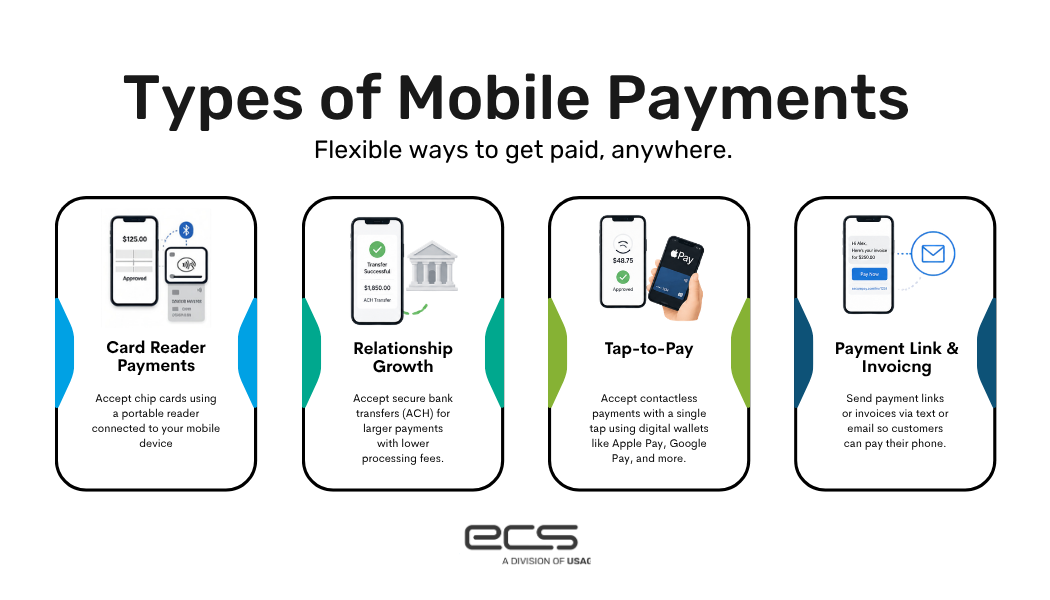
For the pros who don’t always see their clients in person, there are mobile invoicing and payment links. You can send a text to a client with a “pay now” button, and they can handle it right from their own phone.
Many businesses are also leaning into ACH and bank transfer options for larger jobs. It is often cheaper than credit card fees and just as easy to track from a mobile dashboard.
Key Features to Look for in a Mobile Payment Solution
When you are shopping around for a payment provider, don’t just go for the one with the coolest-looking app. You need to look for the “must-haves” that keep your business compliant and efficient.
Your equipment should be EMV-enabled. If you are still swiping magstripes, you are taking on a lot of unnecessary risk for fraud. You also want a system that offers real-time reporting. You should be able to check your sales volume while sitting in your truck between appointments, not just when you get back to a desktop computer.
The real hero here is integration. Your mobile app should play nice with your existing POS or back-office accounting software. If you have to manually type your mobile sales into your main books at night, you aren’t saving time.
Finally, make sure the solution is fully PCI compliant. Don’t skip the importance of securing your transaction flow. This step isn’t just a box to check. Security is what keeps your business from becoming a headline…for the wrong reasons.
Benefits of Mobile Payments for Businesses
The most obvious benefit here is speed. When you accept payments on the go, you are shortening the distance between doing the work and getting paid for it. No more waiting for a check to arrive in the mail or calling a client four times to remind them about an open invoice.
This speed leads directly to better cash flow. When the money hits your account faster, you can pay your bills, buy materials, and grow your business with far less stress. Beyond the money, it creates a much better customer experience. People appreciate being able to settle up instantly. In fact, Gen Z has completely redefined what ‘normal’ looks like in payments, making digital wallets the default and showing little tolerance for outdated payment methods. If your business has to be “tolerated,” chances are the patience will wear thin quickly.
For businesses with remote or field operations, mobile payments offer a level of flexibility that was impossible twenty years ago. You get centralized reporting across all your channels. Whether a sale happens at your main location or out in the field, all the data ends up in one neat pile. This makes your year-end taxes and monthly bookkeeping feel like a breeze rather than a chore.
Who Should Use Mobile Payment Processing
While almost any business can find a use for mobile payments, some industries would be paralyzed without them. Field service businesses, like electricians, HVAC techs, and landscapers, are prime examples. They are rarely in an office, so their “office” has to be their smartphone.
Contractors and home service pros also rely heavily on mobile credit card processing for businesses. If you are a house painter or a pool cleaner, being able to take a payment as soon as the job is done is a massive win. Retail pop-ups, farmers’ markets, and sales teams who travel for trade shows also need mobile POS systems that can handle a crowd without requiring a complex hardware setup or a dedicated Wi-Fi router.
Common Challenges and How to Avoid Them
Even the best tech has its quirks. The biggest hurdle is usually connectivity. If you find yourself in a “dead zone” with no bars, you might worry about losing a sale. To avoid this, some terminals offer an offline mode. This allows you to “store” the transaction and process it once you are back in a service area. Dejavoo is a popular terminal company with this epic feature.
Staff training is another one. If your team finds the mobile reader confusing, they’ll avoid using it. A quick fifteen-minute demo can save hours of frustration later. Watch out also for disconnected systems. If your mobile payments don’t talk to your inventory setup, you’ll end up with “phantom” stock on your website.
How Mobile Payments Can Support Cost Efficiency
Efficiency saves time, yes, but more importantly, it saves money. By moving to mobile, you are cutting out the costs of paper billing, envelopes, and stamps. More importantly, you are cutting out the labor cost of someone sitting at a desk and manually reconciling payments.
When you use a digital system, your transaction accuracy goes through the roof. There’s no more trying to read a customer’s messy handwriting on a check or misplacing a cash payment. Streamlining these small operational tasks can lead to significant overhead reduction over the course of a year. It lets you work smarter, which is always better than just working harder.
How to Choose the Right Mobile Payment Solution
Choosing a partner for your merchant services mobile payments shouldn’t be a snap decision based on a flashy ad. You need to look at the pricing structure. Is it flat-rate, or is it interchange-plus? For many growing businesses, interchange-plus is actually more transparent and saves money in the long run.
Evaluate the ease of use. If the app is clunky, you won’t use it. Check for scalability, too. You might be a one-person show today, but the smart move is working with a system that can easily adapt to handle five employees next year. Finally, don’t overlook customer support. When a card reader fails at 2:00 PM on a busy Friday, you don’t want to be stuck talking to a chatbot.
At ECS Payments, we focus on being more than just a vendor. We want to be the infrastructure that lets you run your business without worrying about the “how” of getting paid. We provide the robust security and high-speed processing of a massive bank, but with the personalized touch of a partner who actually knows your name.
Hear from our Referral Partner Manager, Abe Berg, on how ECS Payments helped a flooring company streamline mobile payments for their on-the-go business operations.
We understand that your mobile payment setup needs to be as reliable as the tools in your truck. Our goal is to make sure your payment technology is the last thing you have to worry about, so you can focus on the actual work that grows your bottom line.
Next Steps
The way we do business is changing fast. Mobile payments are the heartbeat of modern commerce, especially for companies that don’t fit into the four walls of a traditional office. As we move through 2026, the businesses that succeed will be the ones that make it as easy as possible for their customers to say “yes.”
Aligning your mobile tools with your overall payment strategy is the best way to stay competitive. It gives you a clear picture of your finances and the freedom to chase opportunities wherever they lead you.
Take a second to look at your current payment setup. Is it helping you grow, or is it a hurdle you have to jump over every day? If you are still mailing invoices and waiting weeks for checks, it might be time for an upgrade.
Think of mobile payments as a core part of your merchant services strategy. Turn your checkout process into a streamlined engine with the right payment partner, one who offers the right mix of hardware, software, and support. Contact us today to get started with smarter payments.
