Estimated reading time: 9 minutes
Many businesses aren’t struggling with cash flow because they lack customers. They struggle because their payment systems cannot keep up with how customers actually buy… or want to buy. One checkout flow option could live online. Another, at the counter. A third, somewhere in invoicing or email links. Online and in-store payment options are crucial, but how they communicate with customers is even more critical.
The first step would be implementing omnichannel checkout. Offer more ways for customers to shop and pay. But the next step is to ensure that each channel communicates with the system as a whole. System fragmentation creates blind spots, delays, and unnecessary costs in your business. Your business needs omnichannel payments that close those gaps before they quietly erode margins.
As a business owner, it’s natural to assume declined cards or slow deposits are the main cause of payment friction. In reality, however, the bigger problem is visibility. With disconnected systems for your online and in-store payments, reporting becomes unreliable. With unreliable reports, proper decision-making fails. Omnichannel payments unify transactions and reports, giving merchants a clearer view of revenue, customer behavior, and performance across all channels.
This article breaks down what omnichannel payments are and how unified commerce really works. We also dissect why ECS omnichannel payments offers a scalable approach for businesses that want control without complexity.

What Omnichannel Payments Mean
Omnichannel payments means that every way a customer can pay you is connected in a single ecosystem. For a business owner, unified commerce means fewer systems, surprises, and accounting headaches. Omnichannel gives you full insight into the customer journey rather than isolated transactions scattered across platforms. But how does a business successfully implement omnichannel processing?
The answer is simple. It’s with the right payment processor. Many businesses make the mistake of signing off on a run-of-the-mill, or “popular,” off-the-shelf processor. Or maybe their bank offered to process their payments. But going with these options could leave you in a less-than-ideal situation. In many cases, these options are more costly with flat-rate payment structures. But in other situations, and more relevant to this topic, they don’t offer seamless omnichannel solutions.
Without the right payment processor, you may find yourself stuck. 72% of businesses say payment processing impacts their ability to grow. As a result, 43% of business leaders planning to update their payment processes say the goal is to drive growth.
Online, In-Store, Mobile, And Invoicing
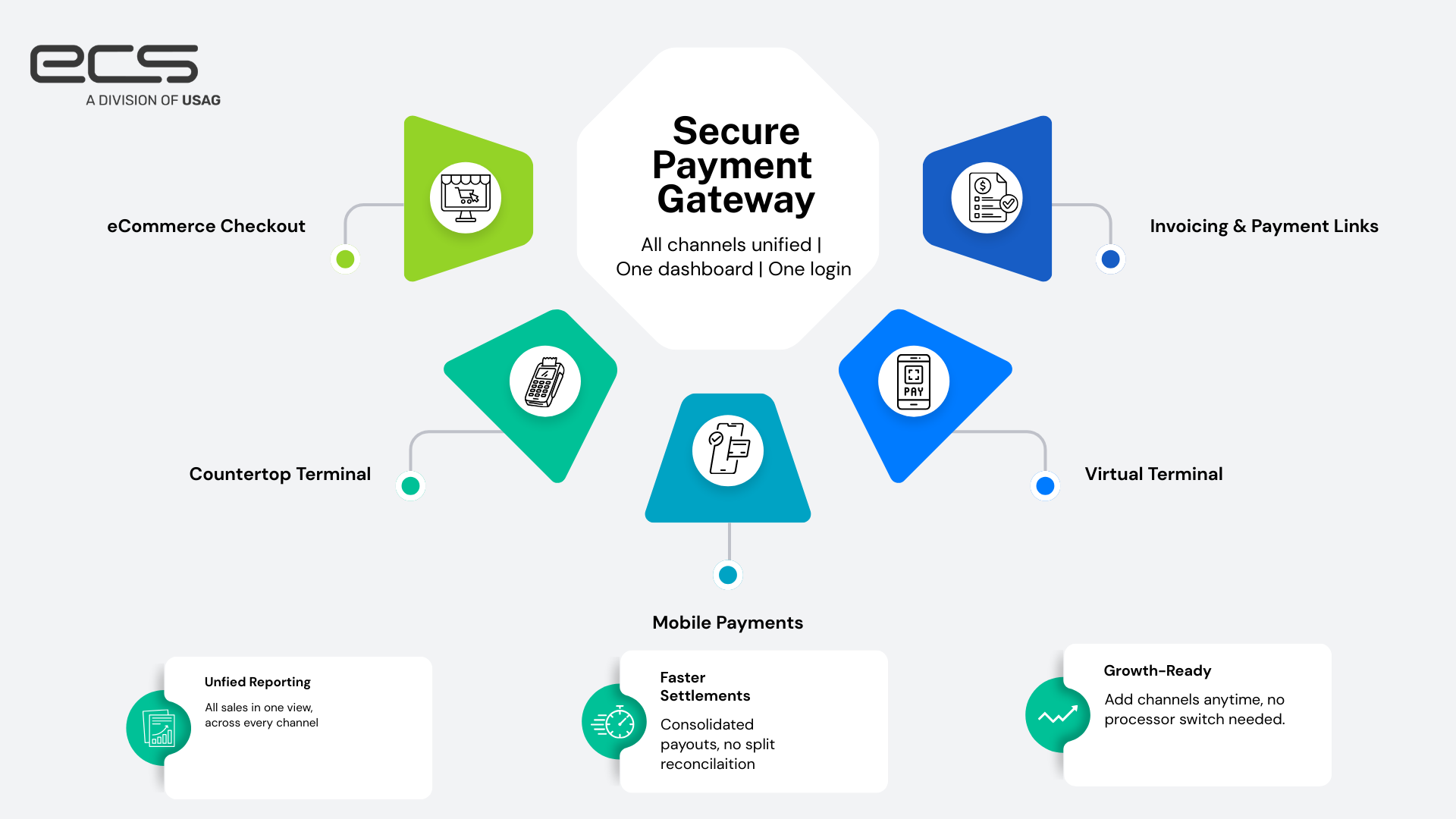
Unified commerce payments typically include eCommerce checkout, countertop terminals, mobile devices, virtual terminals, and invoicing tools. The key difference is that they are not bolted together as afterthoughts. They are designed to work as one.
Everything runs through a secure gateway that connects the different ways you get paid. In-store transactions run through card readers. Phone or manual payments go through a virtual terminal you can access from any browser. When you need to collect money remotely, payment links let you send a secure checkout link without complicated integrations.
The idea is simple. However a customer chooses to pay, you can accept it, without juggling different systems or logins. Whether the payment happens face-to-face or miles away, it still shows up in the same place.
ECS Omnichannel Product Overview
ECS Payments takes a different approach to its partnerships with business owners compared to other processors. Their tools are built to fit how businesses already operate, not force them into a one-way, boxed-in setup.
Some merchants start with a countertop terminal and are comfortable staying there for years, until they are ready to step out and grow. Others need online payments, invoicing, or remote checkout options immediately, depending on their business structure. ECS omnichannel payments are designed so you can start where you are and add pieces as you need them, without having to rebuild everything or switch processors later.
Benefits Of Having All Channels On ECS
Using multiple payment systems does not usually feel like a problem at first. But, over time, it turns into one. Different reports, different fees, and different support teams. When something does not line up, you are stuck figuring out which platform caused the issue.
Even if your business is in-store only right now, that may not always be the case. The Small Business Majority Digital Transformation Report found that nearly half (44%) of small business owners reported eCommerce sales increases of 25% to 100%. Plus, 6 in 10 small businesses used some form of eCommerce platform in 2024. Customers expect online payment options. With eCommerce tools and ECS payment links alongside your in-store terminals, you offer your customers and clients more ways to interact with your business. So, you can expand without adding layers of complexity. Reporting stays in one place. Reconciliation takes less time. Fees are easier to understand.
How Unified Commerce Is Evolving
When online and in-store transactions live together in one system, it’s easier to catch important patterns, such as which channels bring more customers in, which ones customers stick with most, and where sales are slower. Understanding this information can help you with planning and budgeting in ways that separate systems never could.
A Forbes Technology Council analysis report explains that unified commerce becomes more valuable when AI is added, because it helps businesses make sense of scattered sales and payment data. Instead of reacting after problems show up, merchants can spot changes earlier and adjust while there is still time to do something about them.
For business owners, this is why unified commerce payments matter beyond convenience. It is not just about getting paid. It is about having a setup that gives you better answers as customer behavior keeps shifting.
How Different Business Types Use Omnichannel Payments
Of course, ECS omnichannel payments are not limited to one industry. No two businesses run the same way, and omnichannel payments should not force them to do so. ECS omnichannel payments are built to flex depending on how a business operates.
ECS omnichannel payments support online and in-store payments, invoicing, and payment links. With ECS, businesses have the same processor, reporting platform, and support team regardless of which payment channels they use for their transactions.
Retail merchants may be in-person or solely online. But in many cases, often need payments to work just as smoothly online as they do at the counter, with reporting that keeps sales and inventory aligned. Restaurants typically rely on in-store terminals for dine-in patrons. But smart restaurants will add online ordering for takeout, which requires a virtual terminal. And for those who want to expand even more, they could offer catering, which could be settled with a mobile terminal or invoicing links.
Service businesses typically do not need an in-store payment option, but rely more heavily on virtual terminals and ECS payment links to accept deposits, issue invoices, and collect balances without having to chase customers down. For B2B and service-focused companies, unified commerce payments also make it easier to track invoice payments alongside card-present sales. That visibility helps with cash flow planning and cuts down on manual data entry that slows teams down.
How To Add Channels To An Existing ECS Account
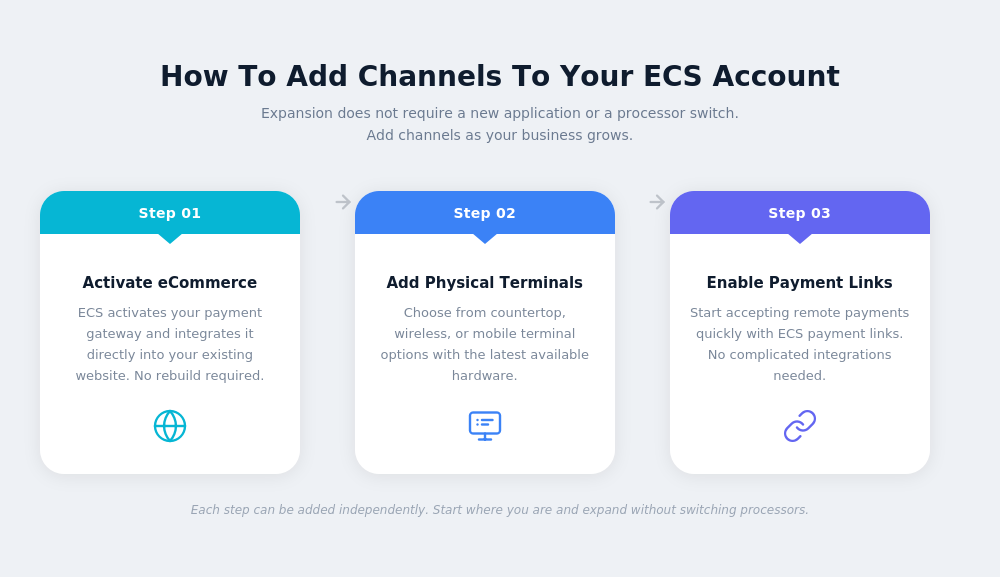
One of the advantages of ECS omnichannel payments is that expansion does not require a complete overhaul or new processing application. Existing ECS merchants can add channels as their business evolves.
To enable eCommerce, ECS’s team would just need to activate the gateway and integrate it into your website. Adding physical terminals is straightforward, with the latest technology available in countertop, wireless, or mobile options. ECS payment links can be enabled quickly for merchants who want to start accepting remote payments. This incremental approach reduces risk and keeps businesses operational during growth phases.
Security And Compliance Across Channels
Keep in mind, when businesses add more ways for their customers to pay, it’s important they understand security regulations across all channels. Each additional channel introduces another place where data can be exposed. When a business has small, unnoticeable PCI compliance gaps, it leaves room for problems, including fraud and data breaches.
With ECS omnichannel payments, security is handled as one connected framework, not a collection of separate tools. PCI compliance is managed across the entire payment environment, so the same standards apply whether a customer pays online, in-store, or through ECS payment links. ECS Payments builds encryption, tokenization, and secure data handling into every channel, which reduces risk and removes the need to manage compliance piecemeal.
Metrics To Track In An Omnichannel Setup
Let’s clear one thing up. More data does not mean things will automatically become clearer. In fact, more data can often add a level of complexity. It matters that you can actually use your data without having to dig through reports. Omnichannel’s goal is to efficiently access all your data. Omnichannel payments show where a sale started and how it finished, not just the final transaction.
One of the first things to pay attention to is where payments are coming from. For example, a business might assume most of its sales happen in-store, only to find that online payments are doing more of the work than expected. When you can see that data clearly, decisions around staffing, hours, and marketing become that much easier.
Moreover, looking at repeat customers is just as important. If your customers tend to make a purchase in person the first time but then return as eCommerce transactions, it tells you where trust is being built. Patterns like this are hard to spot when your payments are mixed up in different systems.
ECS omnichannel payments put those numbers in one place. It’s one platform that streamlines your workflow so you spend less time guessing and more time making adjustments based on what is actually happening in your business.
ECS Payments As A Trusted Omnichannel Partner
ECS Payments aims to educate our merchants and become long-term partners. Our focus is to offer businesses a payment infrastructure that supports their growth and enhances their customer experience from start to finish.
Our expert representatives and adaptable tools are a strong alternative for merchants seeking flexibility without sacrificing reliability. ECS omnichannel payments provide business owners with clarity, control, and sustainable operations with a unified view of online and in-store payments, invoicing, and remote transactions. Mapping your payment ecosystem is no longer optional if you want to scale responsibly.
If you are ready to understand how unified commerce payments can streamline operations and improve visibility, contact ECS Payments today.
