Every day your business operates without a streamlined billing process, you are essentially giving your customers an interest-free loan that your own cash flow cannot afford. Most business owners realize that the gap between finishing a job and actually seeing the funds hit their bank account is the most stressful part of the entire operation.
If your accounting department is still chasing paper trails or waiting on checks to clear through the mail, you are leaving your financial stability up to chance. Electronic invoicing is no longer a luxury for tech-oriented startups. This transition is a fundamental shift in how successful companies manage their liquidity and professional reputation.
What Is Electronic Invoicing?
To understand the impact of this technology, we have to look past the idea of sending an emailed PDF. True electronic invoicing is the digital exchange of a billing document between a supplier and a buyer in a restricted, integrated format. Traditional invoicing relies on manual data entry, physical postage, and the hope that a check gets cut in a timely manner. The electronic version exists as a live data set within your payment solutions for invoicing.
This modern approach removes the middleman of physical handling. Prior to the takeover of digital technology, a merchant printed their bill, stuffed it into an envelope, and sent it into the void. For B2Bs, online invoicing and payments allow for a direct line of communication between your billing software and the client’s accounts payable system. This shift moves the entire process from a passive wait-and-see game to an active, data-driven part of your payment processing strategy.
How Electronic Invoicing Works
Digital invoicing should be as frictionless as possible. It starts with the creation of the document within a centralized platform. Here, you have all client data, pricing, and tax information pre-populated. Once you hit send, the invoice is delivered via a secure link or directly into a customer portal. This immediacy is the first step in learning how to collect payments faster from invoices.
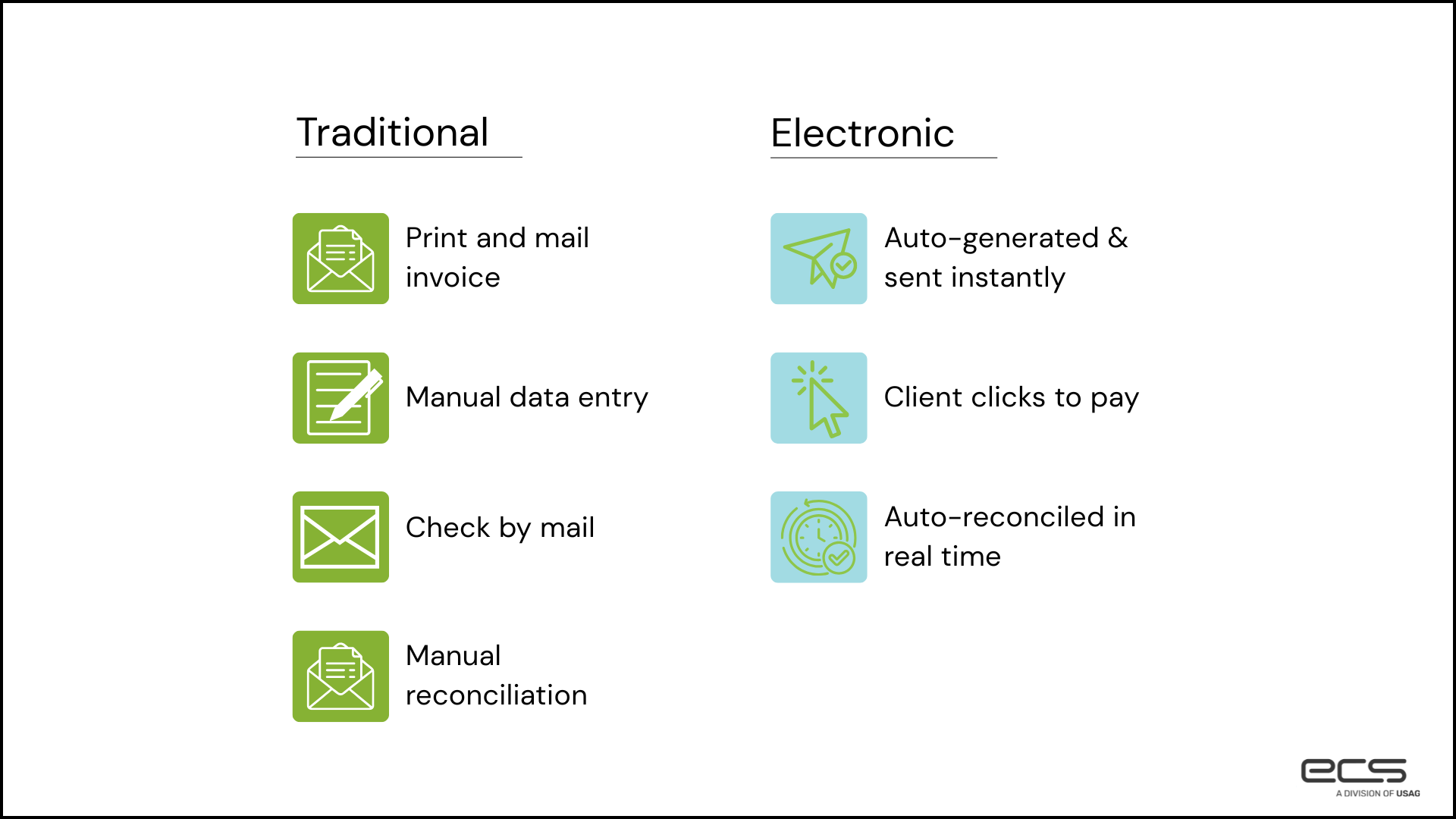
Most high-quality invoicing payment systems for businesses embed payment options directly into the digital document. This means the customer can click a button and pay immediately via credit card, debit card, or ACH transfer. Once customers submit their payment, the system automatically handles the reconciliation. It marks the invoice as paid in your records and updates your general ledger. None of these steps require a single minute of manual data entry from your staff.
Key Features of Electronic Invoicing Systems
A robust system acts as a digital assistant for your financial department. One of the most vital features is automated payment collection for recurring services. If you have clients on a monthly retainer or subscription, the system can generate and send those invoices on a set schedule without any human intervention.
Beyond simple automation, these platforms offer real-time tracking. You can see exactly when a client opened an email and how many times they viewed the invoice. This level of transparency eliminates the common excuse that a bill was lost in the mail. Furthermore, the best B2B electronic invoicing solutions integrate directly with your existing ERP or accounting software. This ensures that your sales data and your bank balances are always in sync, providing a single source of truth for your business finances.
Benefits of Automated Payment Collection
According to data from the Federal Reserve, electronic payments continue to grow at a rapid pace while check payments continue to decline year over year. Embracing electronic invoicing protects your cash flow and ensures your business remains viable in a digital-first economy.
The most immediate benefit of shifting to an automated model is the dramatic reduction in the “Days Sales Outstanding” metric. Businesses that use automated accounts receivable tools often see a 67% drop in the time it takes to receive their funds compared to those using manual processes. The more speed, the better your cash flow. When you know exactly when money is coming in, you can make smarter decisions about hiring, inventory, and expansion.
Beyond the numbers, automation also reduces the mental load on your team. Manual billing is prone to human error, and errors lead to disputes and strained client relationships. By automating your payment collection, you ensure perfect calculation, and punctual and polite reminders every time. This translates to a more professional experience for your customers.
Who Should Use Electronic Invoicing
While any business can benefit from better organization, certain sectors find these tools indispensable. B2B companies are the primary candidates because their deal sizes are often larger and their payment terms are more complex. When you are dealing with net-30 or net-60 terms, having a system that can automate invoice payments is the only way to stay organized at scale.
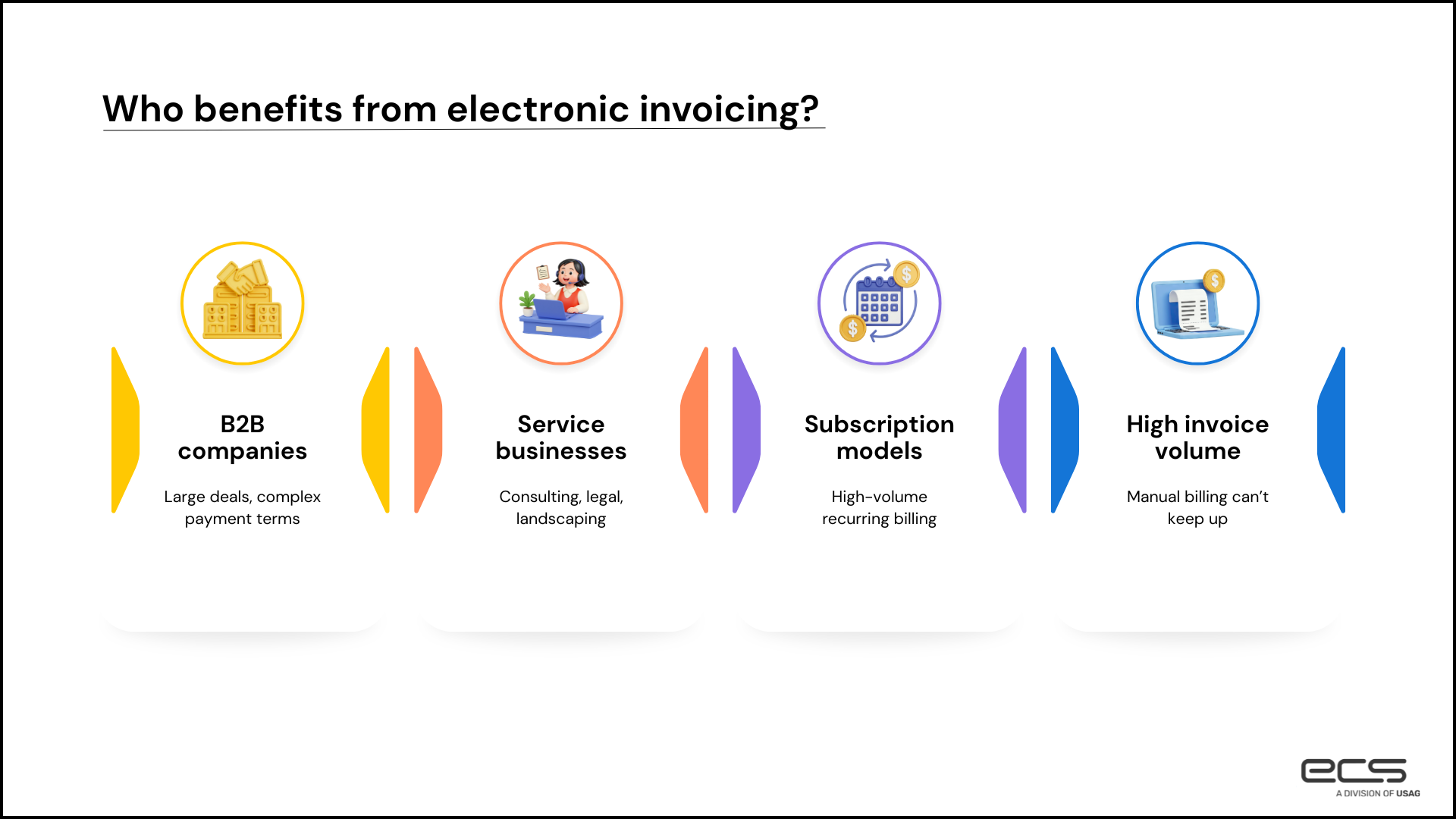
Service-based businesses like consulting firms, landscaping companies, or legal practices also find immense value here. These businesses often deal with fluctuating project costs. Being able to send an invoice from a mobile device the moment a job is completed is a game changer. Similarly, any business that relies on a subscription model or has a high volume of monthly transactions will find that manual billing simply cannot keep up with the growth of the company.
Common Challenges and How to Avoid Them
The biggest hurdle most merchants face is the “check is in the mail” syndrome. When you rely on disconnected systems, you often find yourself in a cycle of manual follow-ups that waste hours of productive time. You might have one person creating the invoice, another checking the bank account, and a third person calling the client to ask about a late payment.
To avoid these pitfalls, you must move toward a unified invoice payment processing system. When your payment gateway and your invoicing tool speak the same language, the “disconnection” vanishes. You avoid the embarrassment of calling a client for a payment they already made because the system updates in real-time. By offering a wide variety of payment options, you also remove the technical barriers that often cause customers to procrastinate on their obligations.
How Electronic Invoicing Supports Cost Efficiency
There is a high hidden cost in traditional billing that many owners overlook. Between the cost of paper, ink, and postage, and the hourly wage of the employee tasked with managing the ledger, each manual invoice can cost a business a surprising amount of money.
Industry benchmarks indicate that the average cost to process a single manual invoice is between $12 and $15. In contrast, businesses utilizing high level automation can reduce those costs by nearly 80% at $2–$4 per invoice.
The American Productivity & Quality Center says that top-performing companies spend about $0.38 per $1,000 in revenue to process accounts payable, while bottom performers spend about $0.92. For a company with $1 billion in annual revenue, this difference can represent over $500,000 in potential savings per year.
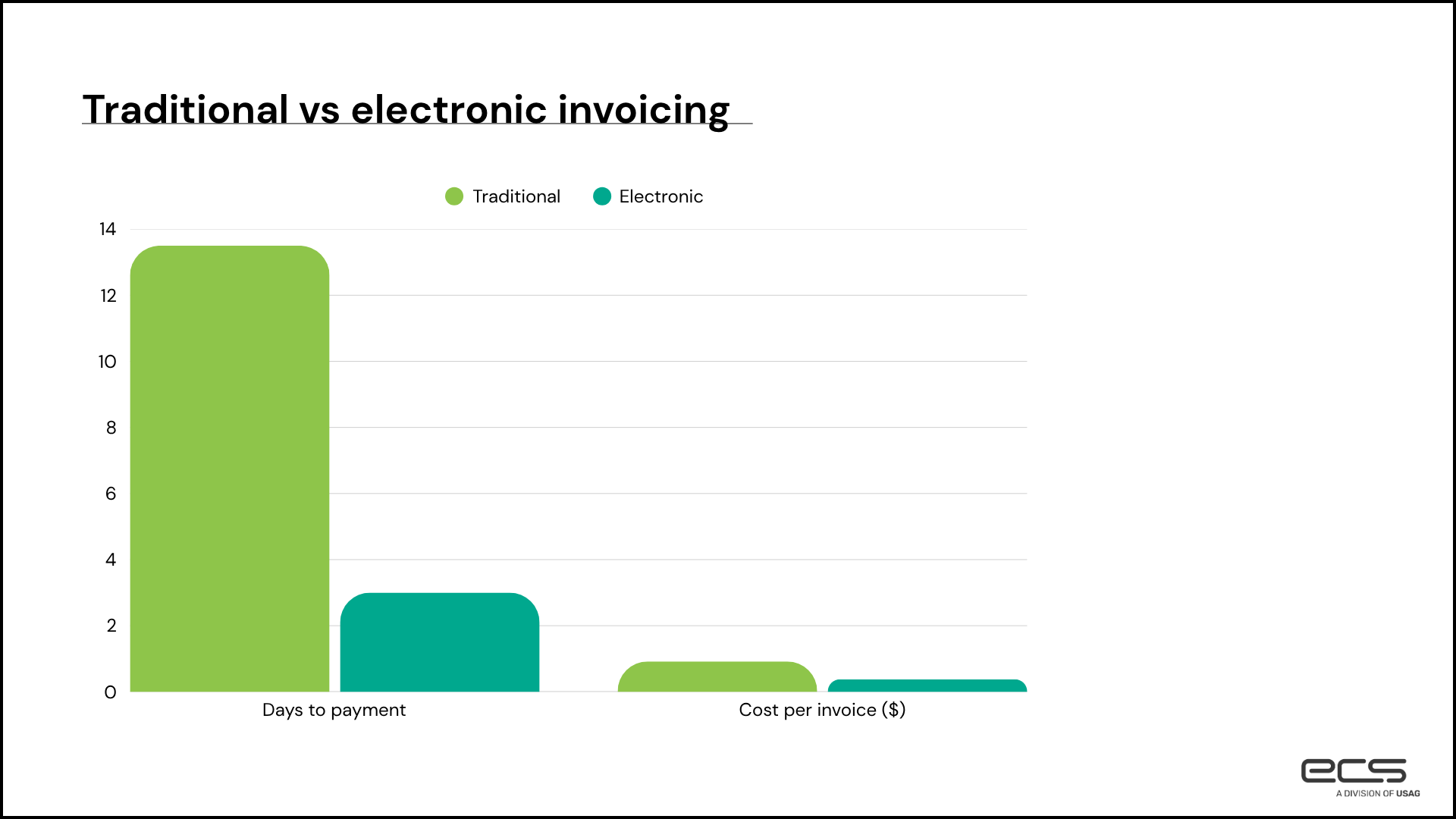
By switching to a digital model, you are effectively cutting those administrative overhead costs to a fraction of their former size. You minimize the time spent on reconciliation, which is often the most tedious part of the accounting cycle. This allows your staff to focus on higher-value tasks, like business development or customer service, rather than chasing down missing signatures or correcting data entry mistakes.
Key Considerations When Choosing an Electronic Invoicing Solution
When you are ready to implement a new system, your first priority should be integration. You want a tool that slides into your current workflow without requiring a complete overhaul of your operations. Security and compliance are equally important. Since you are handling sensitive financial data, ensuring that your provider is PCI compliant is non-negotiable.
Look for a partner that offers pricing transparency. Many processors hide fees in complex contracts, which defeats the purpose of trying to save money through automation. The goal is to find a solution that is as easy for your staff to use as it is for your customers to navigate. If the payment portal is confusing, your customers will revert to sending checks, and you will find yourself right back where you started.
Electronic Invoicing vs Traditional Invoicing
The contrast between the two methods is stark when you look at the lifecycle of a payment. Traditional invoicing is a linear, slow-moving process with multiple points of failure. If the mail is experiencing a delay, the payment is too. If the person who signs the checks is out of the office, your payment is delayed. And what if the check is lost somewhere under a pile of papers on your desk? You aren’t depositing those funds anytime soon.
Digital invoicing is a circular, self-sustaining ecosystem. The delivery is instantaneous, and the cost to send is negligible. More importantly, the customer has a more modernized experience. Most people today prefer to handle their financial obligations digitally. Providing a professional, secure portal for them to pay their bills makes your company look like a forward-thinking leader in your industry, whereas paper bills can make a firm look outdated and disorganized.
Best Practices for Implementation
To get the most out of your new system, start by standardizing your workflows. Decide on your payment terms and stick to them across the board. When you set up your electronic invoicing, make sure you are offering every possible payment method. Some clients prefer the speed of a credit card, while others prefer the lower fees associated with ACH transfers for larger amounts.
Don’t be afraid to lean heavily on automated reminders. Most people don’t intentionally skip out on bills; they simply get busy. A polite, automated email sent three days before a due date and another one on the day it is due can increase your collection rate significantly. Finally, monitor your performance. Look at your reports to see which clients are consistently late and use that data to adjust your terms or follow-up strategy.
The Role of ECS Payments in Your Growth
At ECS Payments, we have spent years refining our merchant services to ensure that our clients have access to the most sophisticated tools for managing their revenue. Our approach to payment solutions for invoicing is built on the idea that your financial data should be accessible, secure, and easy to manage.
We provide the infrastructure that allows you to move away from the clunky, manual processes of the past. Our systems are designed to handle the complexities of B2B transactions while remaining simple enough for a small business to master in an afternoon.
By focusing on security and reliability, we help you build a foundation where you can stop worrying about whether you will get paid and start focusing on how you will scale your next big project. Our commitment to transparency means you always know what you are paying and what value you are getting in return.
Next Steps
More businesses are realizing the efficiency gains of digital systems. So, the companies that stick to manual billing will find themselves at a severe competitive disadvantage compared to those who push toward automation.
Now is the perfect time to audit your current billing and collection process. Look at how much time your team spends on manual entry. Then look at how long invoices settle on average. If those numbers aren’t where you want them to be, it is time to consider a more robust merchant services strategy.
Ready to modernize your business and set yourself up for a much more stable and profitable tomorrow? Contact ECS Payments.
