The silent killer of a growing business is not usually a lack of sales. It is the friction that sits between a completed service and a deposited check. You can have the best product in your niche, but if your collection process relies on chasing paper or playing phone tag for credit card numbers, you are leaking revenue every single month. h. A secure payment portal for customers removes that friction, making it easy for clients to pay quickly and for your business to get paid without delays.
When a client wants to pay you but finds the process cumbersome, that delay directly impacts your liquidity. Implementing a robust customer payment portal is not a luxury reserved for enterprise corporations. It has become a foundational tool for merchants of any size who value their time and professional reputation.

What Is a Customer Payment Portal?
At its most basic level, a customer payment portal is a secure, web-based platform where your clients can view their outstanding balances and settle their invoices independently. It functions as a digital bridge between your accounts receivable department and your customers’ wallets. Unlike traditional invoicing, where you send a static PDF and hope for a return check, this is a dynamic environment.
This technology falls under the broader category of customer payment solutions by moving transactions away from manual entry. In the past, “online payments” might have just meant a “Pay Now” button that led to a generic form. A true payment portal for businesses is more comprehensive. It provides a login-protected space where a client can see their entire relationship with your company in one view. This is the difference between a one-off transaction and a managed account relationship. While traditional invoicing is a one-way communication, a portal is a two-way street that keeps both parties synchronized without a single email or phone call.
How a Customer Payment Portal Works
The lifecycle of an online transaction through a portal is designed to be as invisible as possible. It generally begins when your billing system generates a digital invoice. Rather than just sending the customer an email with the “Total Amount Due,” the customer receives a secure, unique link. When they click this link, they are directed to an online payment portal, often branded with your company logo to build trust.
Once the customer accesses the secure environment, they can review the line items of their bill to ensure everything is correct. (Transparency is the key to reducing the likelihood of disputes in the future. After the customer submits the payment with their preferred payment method, the payment processing portal communicates with the banks in real time. The transaction is authorized, the funds are scheduled for deposit, and the system automatically updates your internal records. This closed-loop system ensures that your books are balanced the moment the customer hits the submit button.
Key Features of an Effective Payment Portal
If you are going to transition your clients to a digital platform, that platform must be superior to the old way of doing things. Security is the non-negotiable starting point. A secure payment portal for customers must utilize high-level encryption and comply with PCI DSS to protect sensitive financial data. Customers will only use a system if they feel their information is safe from prying eyes.
Beyond security, versatility is the hallmark of a high-quality payment portal for businesses. Your portal should have the ability to accept a wide range of payment methods: credit cards, ACH transfers, and digital wallets like Apple Pay, Google Pay, and Samsung Pay. Options ensure you meet the customer where they are. Additionally, the portal should offer invoice presentment and a full transaction history. If a client can log in and download their past receipts or see exactly what they paid six months ago, they will not have to call your office to request copies. This self-service aspect is bolstered by real-time tracking and automated confirmations, providing the payer with immediate peace of mind.
Benefits of Using a Customer Payment Portal
The most immediate impact of adopting an online payment portal is the acceleration of your cash flow. When you make it easier for people to pay, they pay sooner. Statistics show that digital payment options significantly reduce “Days Sales Outstanding.” Businesses that embrace integrated digital billing see a marked improvement in operational efficiency and a reduction in the time it takes to convert a sale into cash by 5-10 days.
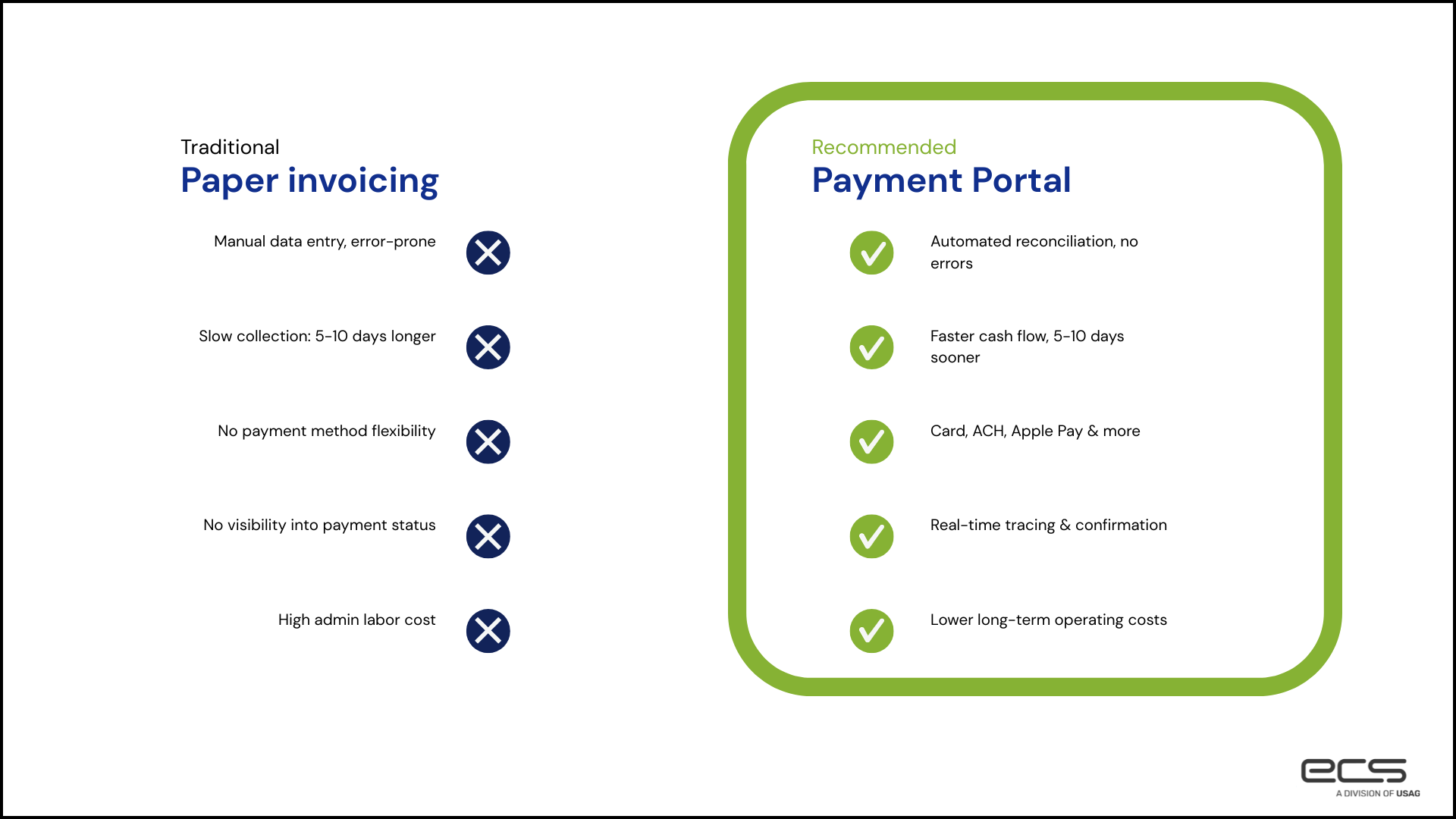
Beyond just speed, you gain incredible visibility into your finances. You can see exactly who has opened their invoice, who is currently viewing the portal, and who has a payment pending. This reduces the manual workload for your administrative staff. Instead of spending hours matching checks to invoices and driving to the bank, your team can focus on higher-value tasks, such as customer service or business development.
Furthermore, a customer payment portal provides a centralized reporting hub. This means your end-of-month reconciliation becomes a matter of a few clicks rather than a weekend of spreadsheet gymnastics.
Who Should Use a Payment Portal
While almost any merchant can benefit from digital payments, certain business models find a payment portal for businesses to be an absolute necessity. B2B companies are at the top of this list. Business-to-business transactions are often larger and more complex than retail sales. Ultimately, B2B payment portal solutions better handle partial payments, multiple cost centers, and detailed purchase orders that a standard checkout page cannot manage.
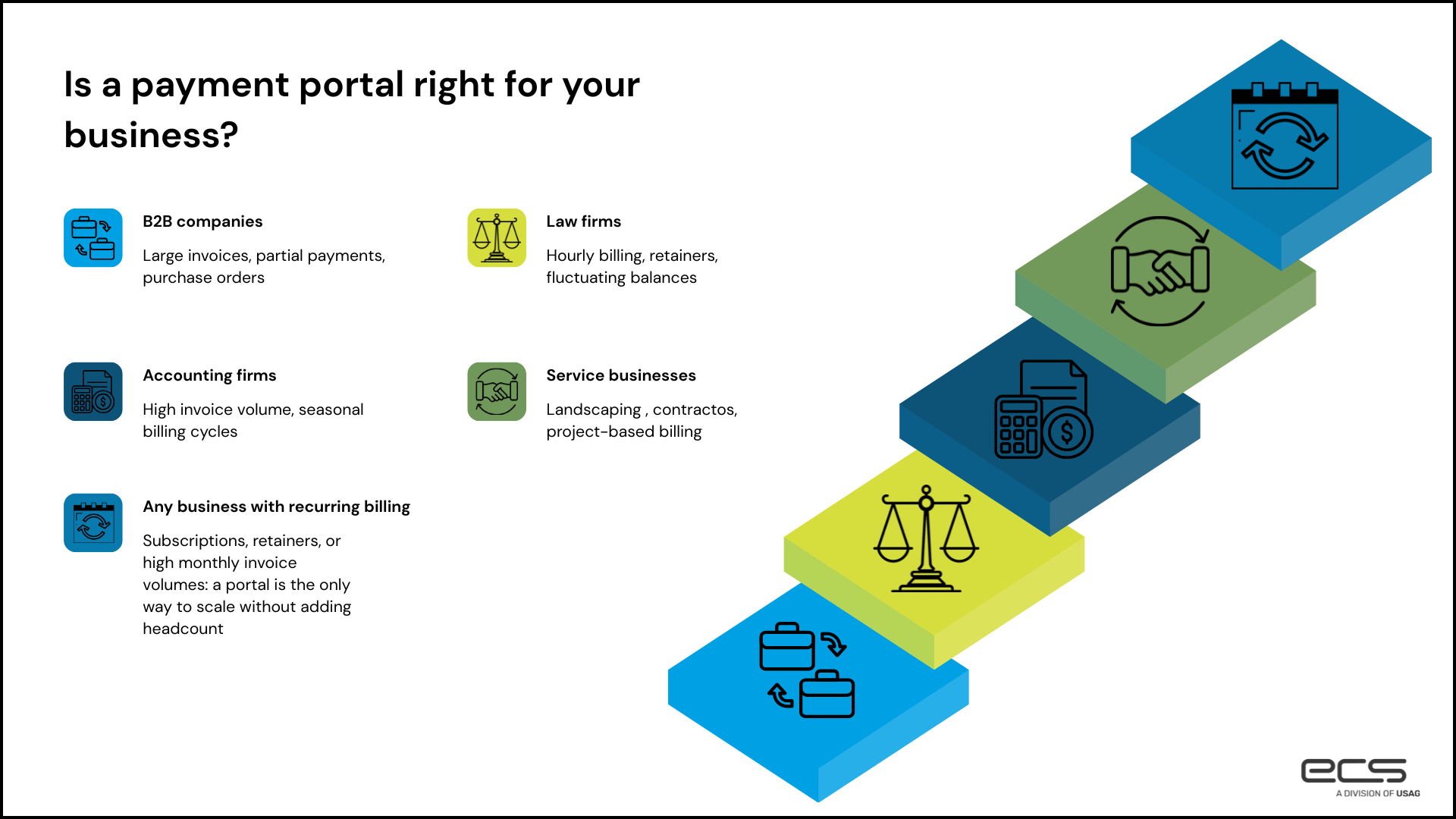
Service-based companies, such as law firms, accounting practices, or landscaping businesses, also find these portals transformative. When your billing is based on hours or project scopes that fluctuate, giving customers a central place to track those costs is vital. Furthermore, any business that manages recurring billing or high monthly invoice volumes will find that a portal is the only way to scale without adding significant headcount to the accounting department.
Common Challenges and How to Avoid Them
The primary hurdle to a successful customer payment portal implementation is often a poor user experience. If the portal is difficult to navigate, or worse, requires a cumbersome registration process, customers will revert to sending checks. You want to choose a solution that is intuitive and mobile-friendly. Many people now manage their business finances from a smartphone, so your portal must work perfectly on any device.
Another common pitfall is a lack of system integration. If your payment processing portal does not talk to your accounting software, you end up creating more work for yourself through manual data entry. You should also ensure you are offering enough payment options. Limiting a customer to credit cards when they prefer ACH for lower fees can create unnecessary friction. Finally, never overlook security. Data breaches are expensive and damaging to your brand. Always work with a provider that puts compliance and data protection at the forefront of their technology.
How Payment Portals Support Cost Efficiency
Every manual step in your billing process has a dollar value. When an employee has to print an invoice, stuff an envelope, mail it, and then manually record the payment later, you are paying for that labor. A customer payment portal slashes these administrative costs by automating payment delivery and recording. This efficiency extends to reducing human error. Manual data entry is prone to mistakes that lead to payment disputes or lost revenue.
Accelerating the payment cycle also has a secondary cost benefit. It reduces the need for short-term credit or lines of credit to cover operational gaps. When your money is in your account faster, you are more agile.
According to a recent study, 48% of businesses in the United States agree that the shift toward electronic payments is a primary driver of lower overall business costs. By streamlining reconciliation, you also save on professional accounting fees during tax season or audits.
How to Choose the Right Payment Portal Solution
Your customer payment solution directly affects how your customers experience your business. And in all cases, you want to ensure they are having a positive experience. Selecting the right partner for your payment solution is a decision that will affect your business for years to come.
The first thing to look for is seamless integration. Your portal should easily integrate with your existing workflow and connect directly to your ERP or accounting software. Easy integration ensures that your inventory, sales, and tax records are always in sync.
Customization is another key factor. You want a portal that looks and feels like your business. This consistency builds trust with your clients. You should also look for a provider that offers transparent pricing.
Additionally, some processors hide fees in complex contracts, so look for a partner that explains exactly what you are paying for.
Scalability is equally important. Your online payment portal should be able to handle 10 invoices a month today and 10,000 a month 3 years from now.
The ECS Payments Advantage
ECS Payments stands out for its personalized service and technical sophistication, qualities often missing from larger, “cookie-cutter” processors. Many business owners feel like small fish in a big pond when dealing with massive financial institutions. ECS Payments flips that dynamic by providing tailored customer payment solutions that are built around the specific needs of your industry.

The advantage of working with a focused provider like ECS is the depth of the partnership. It’s far beyond a piece of software. You get access to a team that understands the nuances of payment security and full-support merchant services. Expertise is crucial when you are trying to optimize your payment flow or resolve a technical issue.
ECS Payments provides the high-tech infrastructure of a global leader with the high-touch service of a dedicated partner, making it a premier choice for businesses looking to professionalize their billing.
Best Practices for Implementation
A successful rollout of an online invoice payment system requires clear communication. Do not just switch systems overnight. Tell your customers that a new, easier way to pay is on the way. Highlight the benefits for them, such as 24/7 access to their accounts and the ability to pay via their preferred method. A simple onboarding process is key to high adoption rates.
Once the system is live, maintain consistent invoicing workflows. If customers know to expect their digital invoice on the first of every month, they are more likely to include your payment in their cash flow planning. You should also regularly monitor the system.
Look at the data to see if there are points where customers are dropping off or if certain payment methods are failing more often than others. Optimization is a continuous process. It ensures your customer payment portal remains a valuable asset to your business.
Next Steps
The role of the customer payment portal is only going to grow. As more businesses move toward digital-first models, the expectation for instant, secure, and transparent payments will become the standard. It provides a professional experience that reinforces your brand’s value every time a client interacts with it. Aligning your merchant services strategy with these expectations is a move that protects your future.
According to a SCORE study on small-business payment trends, the ability to accept digital payments is one of the top factors in determining long-term viability. Modern payment technologies provide customers with a seamless payment experience while also minimizing manual processes and enhancing security.
Now is the time to take a hard look at your current invoicing and payment workflows. If you find that your team is spending too much time on manual tasks or if your receivables are lagging, it is a sign that your current system is holding you back. Evaluate your needs and consider how a professional payment processing portal could fit into your broader strategy.
Transitioning to a complete payment solution suite is an investment in your company’s infrastructure. With ECS Payments, you have the tools, security, and support you need to grow. Contact us today to learn more.