
A payments dashboard should do more than display transaction data. It should help different teams inside the business quickly understand what is happening inside the payment stack and why it matters. Finance teams rely on payment data to reconcile revenue, monitor processing costs, and verify settlement accuracy. Product and operations teams depend on the same data to track approval rates, diagnose failed transactions, and measure the impact of checkout changes.
The challenge is that these teams approach payment data with very different priorities. Finance leaders focus on financial accuracy and historical reporting, while product teams need immediate operational insight. If a dashboard has only one perspective in mind, the result is usually a cluttered reporting tool that neither group fully trusts. Designing a payments dashboard that people actually use starts with understanding who the dashboard is for and the specific questions each department needs it to answer.
Defining the Audience and Use Cases
A one-size-fits-all report serves nobody. While both departments will use a payment performance dashboard, a CFO and a Product Manager are hunting for different answers. Your finance team prioritizes the bottom line and reconciliation. Their work is often focused on the past to ensure the books are accurate and balanced.
On the other hand, your product and operations teams are focused on the present. They need to know if a specific payment method is failing or if a new geographic market is seeing an unusual amount of technical declines. Their use case is highly actionable and immediate. If they notice a dip in the payment analytics dashboard, they need the ability to drill down into the technical response codes right then and there.
The design must support these different speeds of business. You should create an interface that allows for a five-minute daily health check for operations and a comprehensive monthly review for executives. If the dashboard is too cluttered with technical logs, the finance team will find it unusable. If it is too high-level, the product team cannot find the root cause of a checkout failure.
Must-Have Components of a Payments Dashboard
Every effective payments dashboard starts with high-level key performance indicators that act as the vital signs of the business. At the very top of the view, you should find your total processing volume, average transaction value, and overall authorization rate. According to a report by J.P. Morgan on payment trends, businesses that actively optimize their payment performance can significantly improve their top-line revenue by identifying and removing friction points in the customer journey.
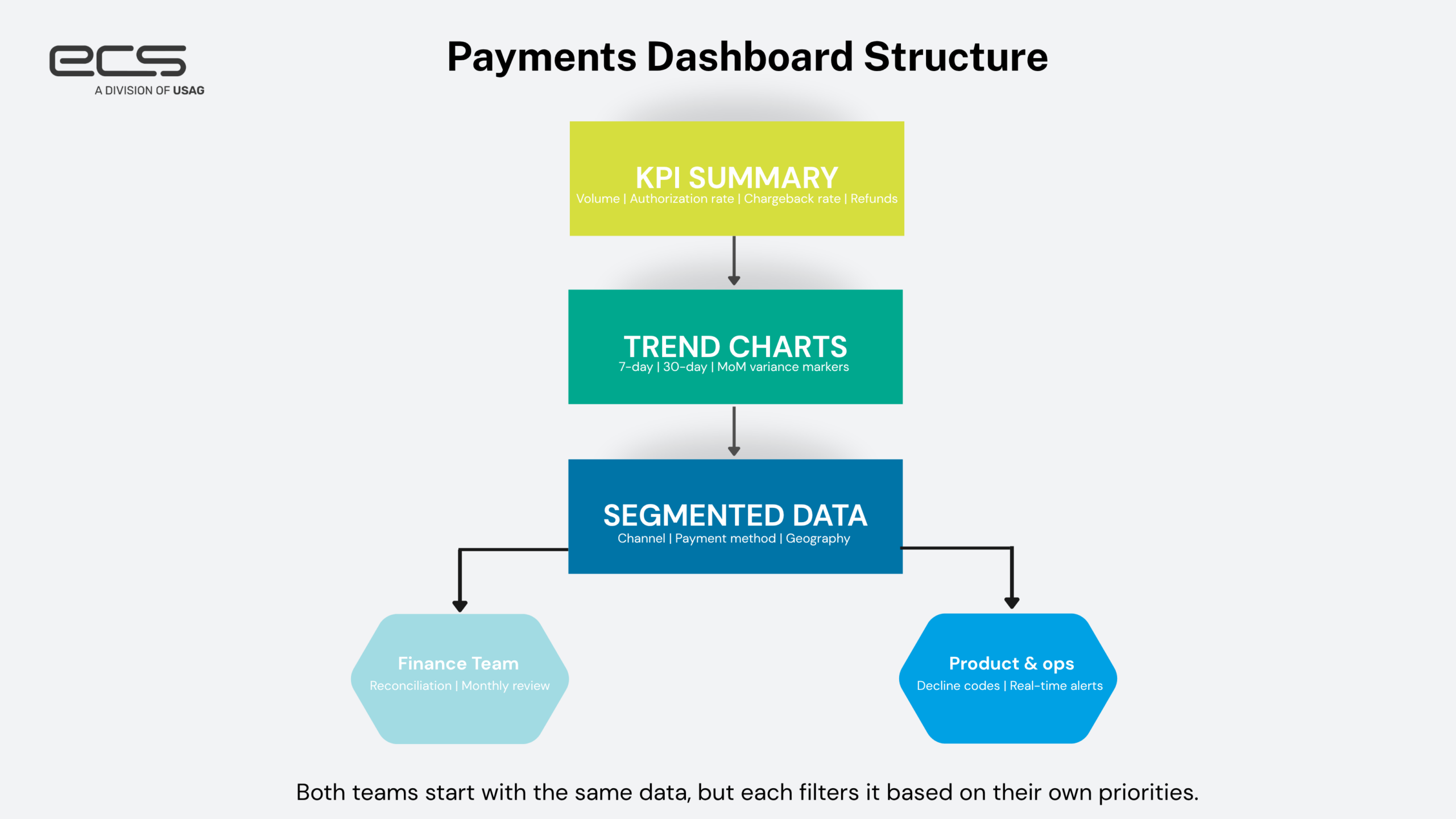
Beyond volume, you should absolutely track your chargeback rate and refund ratios. Both of these metrics serve as an early warning system for your business’s health, or lack thereof. If your chargeback rate starts to climb toward one percent, you are not just losing money but also risking your standing with the card networks. A comprehensive payments reporting strategy should display these metrics as trend charts rather than static digits. A single number tells you where you stand today, but a line chart shows you where you are headed. If you see declines trending upward while your traffic remains steady, you have a technical friction point that requires your attention.
Recommended Views and Slices
Data is only useful if you can break it down into meaningful segments. A global view often masks the very problems you need to solve. For instance, your overall approval rate might look perfectly fine at 85%, but a closer look at your payment performance dashboard could reveal that your mobile app channel is actually struggling at sixty percent while desktop transactions are nearly perfect.
You should design your dashboard to allow for easy filtering by channel, payment method, and geography. If you are an international merchant, you need to see how local currency conversions and cross-border fees are impacting your actual margins.
Furthermore, slicing data by customer segment or subscription tier can reveal which parts of your product are the most profitable. A specific high-value customer group might have a higher decline rate due to aggressive fraud filters, which is a problem you would never identify without a granular payment analytics dashboard.
Operational Monitoring and Alerts
Reporting is a passive activity, but monitoring is an active one. The most valuable payment dashboard is one that alerts you when something is wrong, so you do not have to go looking for it. You should establish baseline thresholds for your most critical metrics based on historical performance. If your approval rate typically stays at ninety percent and it suddenly drops to seventy percent over a two-hour window, the system should trigger an automated notification.
These alerts must be segmented by their level of urgency. A minor increase in refunds over a week might just require a standard email update to the operations manager. However, a gateway outage or a sudden spike in fraudulent transaction attempts should trigger a real-time alert. A proactive strategy ensures that a small technical glitch does not turn into a permanent loss of customer trust. As noted in the 2023 AFP Payments Fraud and Control Survey, 79% of organizations were targets of payment fraud in 2024, which proves why real-time monitoring is a requirement for modern merchants.
Data Sources and Integration Considerations
A dashboard is only as reliable as the data that feeds it. This usually involves integrating information from your payment gateway, your payment processor, your CRM, and your internal billing system. If these systems are not perfectly synced, you will face reconciliation errors where your dashboard shows one hundred sales, but your bank account only shows ninety-five deposits.
Many fail to account for gross versus net settlements or the time it takes for funds to clear. Pull data through clean API connections rather than relying on manually uploading spreadsheets. Manual data entry is the enemy of accuracy, and human error can lead to significant strategic mistakes. You want a system that updates automatically so that the data is fresh every time a team member logs in.
Design Best Practices for Adoption
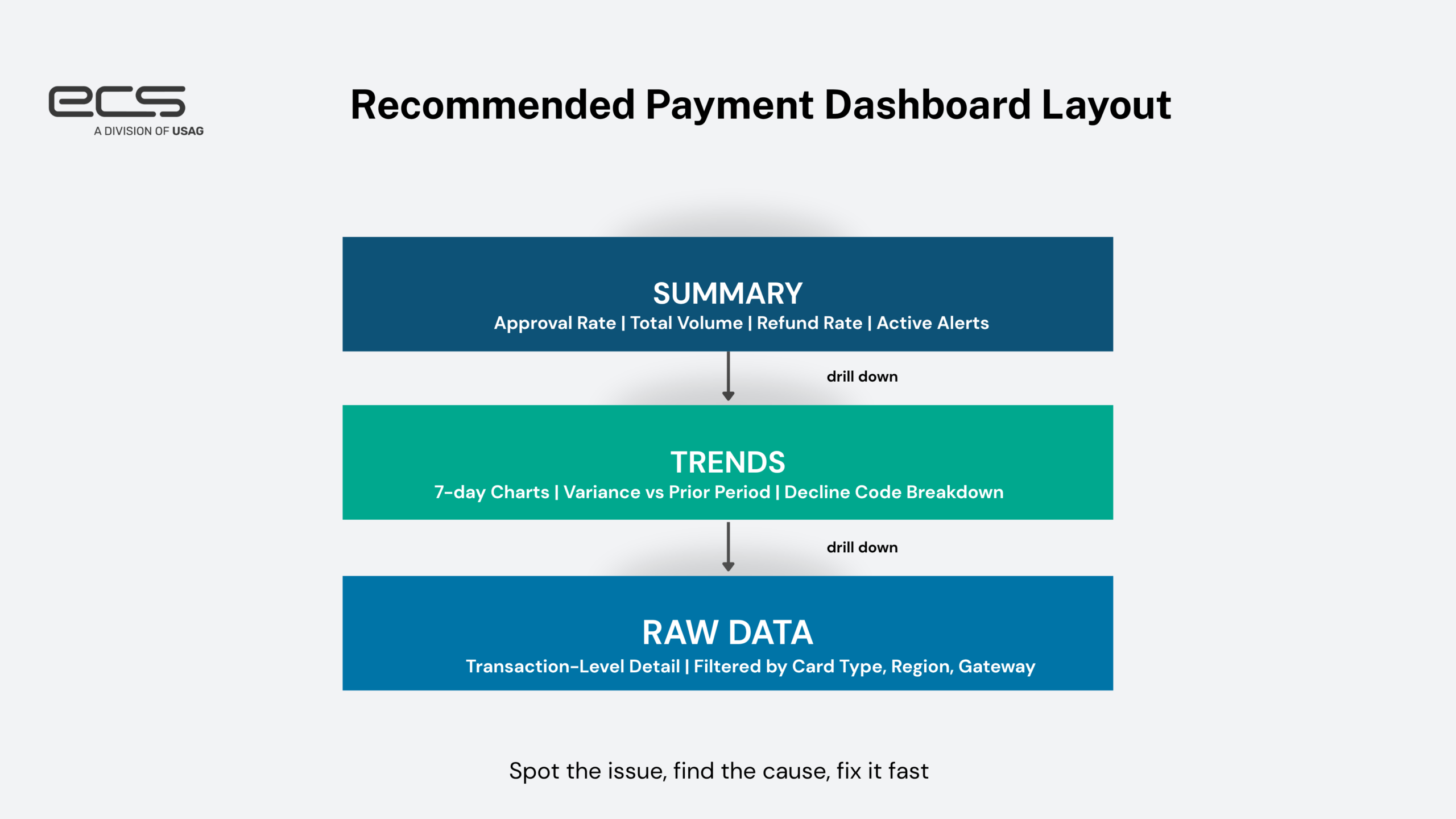
If a dashboard is difficult to navigate, your team will eventually stop using it. Use a clear layout that follows a logical hierarchy:
- a summary at the top
- trends in the middle
- raw data at the bottom.
Filters should be intuitive and remain active as the user moves between different views.
Drill-down capabilities are also a necessity. If a Product Manager sees a spike in “Do Not Honor” codes, they should be able to click that metric to see exactly which card types or regions are being hit.
To make these dashboards truly actionable, include variance markers. Instead of just showing a number, show how much it has changed compared to the previous period. A simple indicator showing a 5% increase or a 10% decrease gives immediate context. And while you want transparency, not every employee needs to see the specific names and card details associated with every transaction. A good payments dashboard balances deep information with strict security and ease of use.
Why ECS Payments is Your Strategic Partner
Building a professional reporting environment is a major challenge when you are working with a processor that treats your data like a secret. At ECS Payments, we believe that transparency is the cornerstone of a successful merchant relationship. We provide the tools and the data clarity that businesses need to build a high-functioning payments dashboard without the typical hurdles of legacy systems.
While many processors offer rigid, basic reports that are difficult to export or integrate, ECS Payments focuses on providing granular and accessible data. We position ourselves as the perfect alternative to the “one size fits all” approach of larger institutions. By offering deep insights into interchange costs, processing efficiency, and fraud trends, we empower you to optimize your payment stack for maximum profitability. At ECS Payments, we securely process your transactions with a cost-effective rate and provide the data infrastructure to help you clearly understand them.

Conclusion
The difference between a business that stays stagnant and one that scales often comes down to how quickly it can react to its own internal data. A well-designed payments dashboard turns raw numbers into a strategic roadmap. According to research from the Federal Reserve on business payment trends, the shift toward digital and real-time payment monitoring is accelerating, making sophisticated payments reporting a competitive necessity for every merchant.
Take some time this week to identify where your reporting gaps currently exist. Are you still manually pulling data from three different portals? Are your teams arguing about which spreadsheet is the most accurate? If you are ready to stop guessing and start growing, it is time to build a payment performance dashboard that actually serves your business goals.
