Every time a customer clicks the buy button on your website, a silent, high-stakes communication happens between banks that can make or break your day. You might assume that if a customer has the funds, the transaction goes through. Unfortunately, merchants lose billions of dollars in legitimate revenue every year simply because the plumbing of the internet isn’t always reliable.
These invisible technical glitches and overly sensitive fraud filters are eating your profits before you even see them. This is where smart payment routing becomes the most important tool in your arsenal. It is the difference between a successful sale and a frustrated customer who abandons their cart forever. When you understand how to navigate the complex web of global banking, you stop leaving money on the table.

The Hidden Cost of Failed Payments
A failed transaction is rarely just a one-time loss of a sale. For a business owner, it represents a complete breakdown of the trust you worked so hard to build through marketing and product development. If a loyal customer tries to renew a subscription or buy a gift and gets an “Error” message, their first instinct isn’t usually to call their bank. Their instinct is to wonder if your site is broken or if they should just try a competitor instead.
The cost of failed payments for merchants includes not only the lost revenue but also the labor costs of manual recovery and the high price of customer churn. Merchants often find that the true cost of a decline is nearly three times the value of the transaction itself. This happens because you’ve already paid for the customer acquisition. You’ve paid for the clicks, the email campaigns, and the site hosting. To lose the finish line because of a rigid processing setup is a tragedy for your bottom line.
Using smart payment routing allows you to move away from a “one-and-done” mentality. Instead of letting a single decline dictate the fate of a sale, you can create a dynamic path that ensures every legitimate dollar finds its way into your merchant account.
What is Smart Payment Routing?
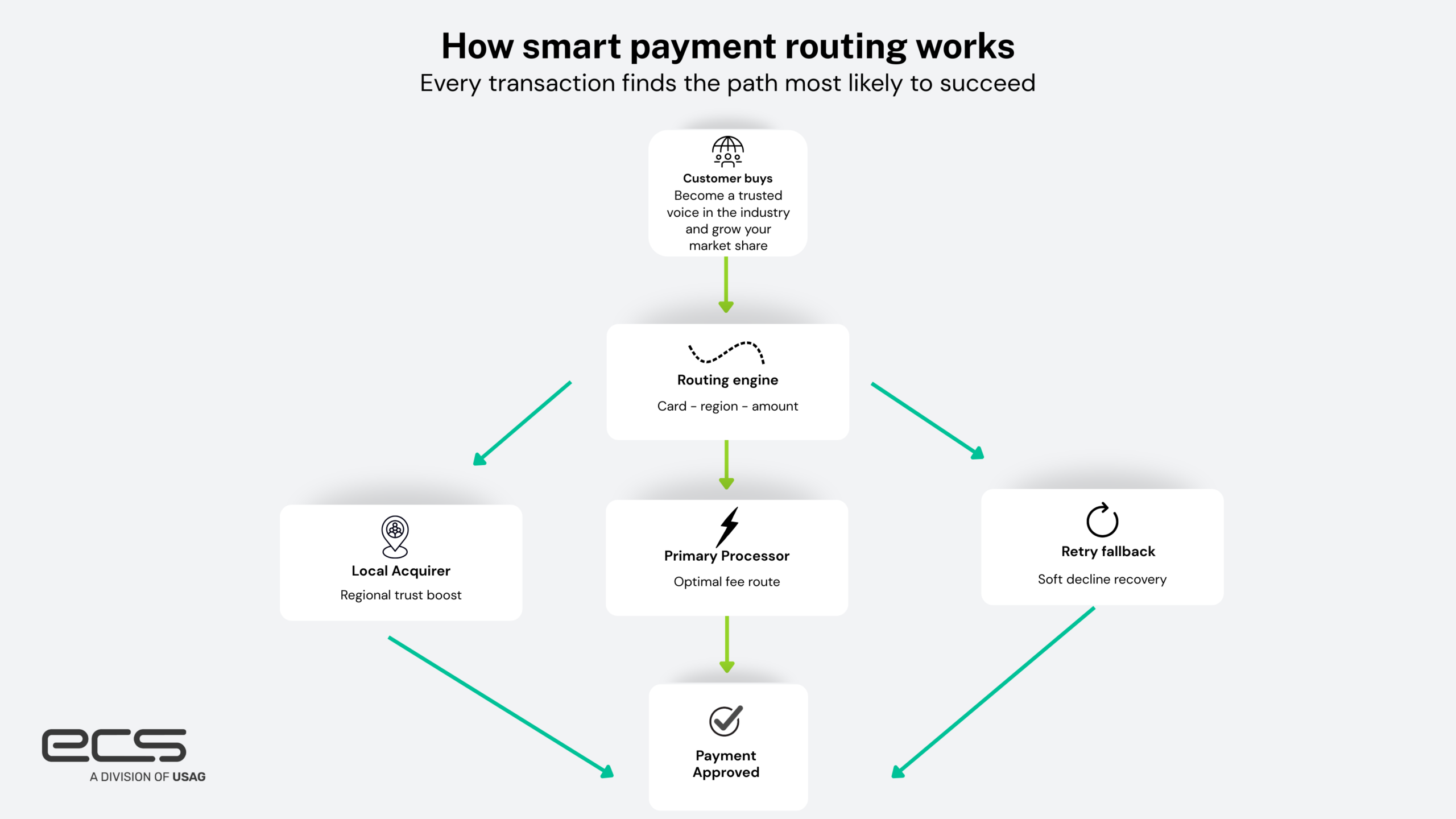
To understand smart payment routing, think of it as a GPS for your money. In a traditional setup, every payment follows the exact same road to the same bank. If there is a “traffic jam” or a technical outage on that specific road, the payment dies. With intelligent routing, your system looks at the variables of that specific transaction and chooses the path most likely to result in an approval.
This process involves directing transactions across a network of different acquirers, payment methods, and geographic regions. If a customer in the UK is buying from your US-based store, a single processing path might look suspicious to a local bank. However, if you route that payment through a local European acquirer, the “trust” level of that transaction skyrockets. This isn’t just about saving a failed sale. It is about payment orchestration, which is the art of managing multiple payment service providers through a single point of control to ensure your business remains agile and profitable.
Core Routing Strategies That Improve Authorization Rates
The goal of smart payment routing is to achieve authorization optimization by sending the right data to the right place at the right time. There are several variables you can use to set these rules.
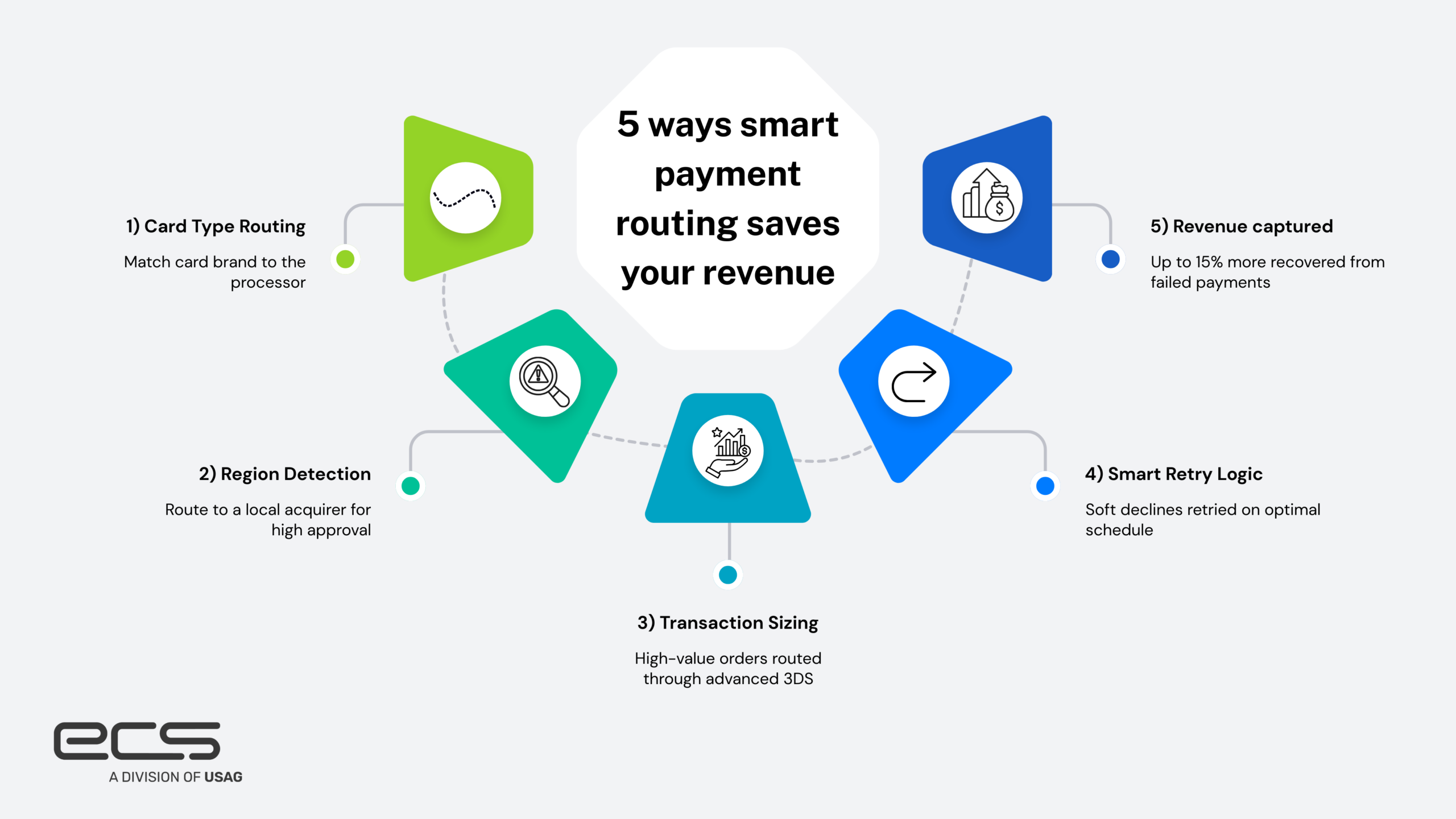
- Card Type and Brand: Certain processors have better relationships or lower fees with specific card brands like Visa or American Express. By routing based on the card type, you can improve the odds of a “yes” from the issuer.
- Issuer Region: This is perhaps the most impactful strategy. Local transactions almost always have higher approval rates than cross-border ones. Routing a Japanese card through a Japanese bank is a game changer for international scaling.
- Transaction Amount: High-ticket items are often flagged for fraud. You can set rules to route transactions over a certain dollar amount through processors that utilize more advanced 3DS security protocols to verify the buyer.
When you implement these strategies, you are essentially speaking the “language” of the issuing bank. You are providing them with the context they need to feel comfortable approving the transaction.
Retry Logic for Failed Payments
Sometimes, a payment failure is only temporary. The bank’s server could have had a millisecond of downtime, or the customer may have hit a temporary daily spending limit. This is where payment retries come in clutch. A “hard decline” means the account is closed or the card is stolen, and you should never try those again. But a “soft decline” is often just a polite “not right now.”
Effective failed payment recovery requires a sophisticated retry schedule. You don’t want to hammer the bank five times in five seconds, as that looks like a bot attack and will get you blacklisted. Instead, you might retry the payment twelve hours later, or perhaps on a Friday when many people receive their paychecks. Utilizing optimized retry logic can significantly boost recurring billing success rates and recovery of up to 15% of what would have otherwise been lost revenue.
Protecting Customer Experience During Recovery
While we want to recover every cent, we have to be careful not to alienate the human on the other side of the screen. No one likes looking at their bank statement and seeing seven “pending” charges for the same pair of shoes. It looks unprofessional and can cause the customer to file a chargeback out of fear.
Transparency is your best friend here. If a payment fails, your messaging should be helpful rather than accusatory. Instead of saying “Your card was declined,” try “There was a hiccup with your bank. We will try again in a few hours so you don’t lose your order.” This keeps the customer in the loop and prevents them from trying to re-enter their info over and over again, which only complicates your data. You want to automate the recovery behind the scenes so the customer experience remains seamless.
Leveraging Payment Orchestration Platforms
Managing all these rules manually is impossible for a growing business. This is why many merchants turn to payment orchestration platforms. These systems act as a central brain that sits on top of all your different payment gateways. They use machine learning to analyze millions of transactions and determine which routing path is currently performing the best.
Over time, the data collected by these platforms allows you to refine your smart payment routing rules, ensuring that your costs stay low and your approval rates stay high. It turns your payment setup from a static utility into a competitive advantage.
Why ECS Payments is Your Strategic Partner
In the world of processing, you often have to choose between a giant, faceless corporation that treats you like a number or a small provider that lacks the technology to scale. ECS Payments bridges that gap. We specialize in providing the high-level smart payment routing technology usually reserved for enterprise-level corporations, but with the personalized service that business owners actually need.
We understand that authorization is the lifeblood of your cash flow. While many processors are happy to collect fees on your successful transactions and ignore your declines, ECS Payments takes a proactive approach. We work with you to analyze why your payments are failing and implement the payment retries and routing strategies necessary to fix them. We pride ourselves on being an authoritative partner that looks at your merchant statement as a puzzle to be solved, not just a bill to be sent.
Conclusion: Take Control of Your Revenue
When you take control of smart payment routing, you stop being a passive observer of your own revenue. You empower your business to navigate technical hurdles, bypass regional biases, and recover funds that would have otherwise vanished into the digital void.
If you haven’t looked at your decline codes lately, you are likely missing out on a significant percentage of your potential growth. It is time to move beyond basic processing and embrace a strategy that works as hard as you do.
Interested in a complimentary audit of your current payment setup? Contact ECS Payments to get started on a better business setup.
