Imagine a customer walking into your shop, reaching for their wallet, and realizing they left it sitting on the kitchen counter. In the past, this was a guaranteed lost sale and a frustrated consumer. Today, that same customer simply taps their wristwatch to pay. In the near future, it could be a sleek titanium ring against your terminal to pay. The friction of the physical wallet is dissolving before our eyes. If your business is still relying on the “swipe and sign” era of commerce, you are likely feeling a quiet but persistent disconnect from the modern shopper.
As consumer behavior settles into these new patterns, business owners must look beyond the plastic card in their pocket. Understanding this shift helps to ensure your checkout experience does not become a bottleneck for your growth.
“The idea is very straightforward: What if this is your key? What if this is your wallet?” – Tom Hale, CEO, Oura
How Wearable Payments Are Changing With The “Ring Revolution”
The smart ring market is currently in a state of high tension. On one side, we have health giants like Oura and Samsung focusing on sleep and heart rate. On the other hand, we have a growing demand for “ambient payments,” where shoppers never have to reach for a device. While the current generation of many popular rings does not yet support active payment wallets, the industry is moving rapidly toward total integration.
More than half of American shoppers have replaced traditional payment methods with contactless options because they are faster. For the smart ring, adding a secure payment chip is the “holy grail.” This addition will move these devices from a niche fitness tool to a mass-market essential.
Introducing The Rumored Apple Ring
While we have grown accustomed to seeing people tap their iPhones or watches, the hardware is getting even smaller. Rumors suggest that Apple is exploring a smart ring to compete with the popular Oura and Samsung devices. While there is no official confirmation of a release date, the strategic logic is clear. A ring represents a new “always-on” consumer. Unlike a watch that might be removed for charging or a phone that might be buried in a bag, the smart ring is designed for 24/7 wearability.
Based on current industry insights and market projections for late 2026 or early 2027, here is what you should know about the potential for an Apple-branded wearable:
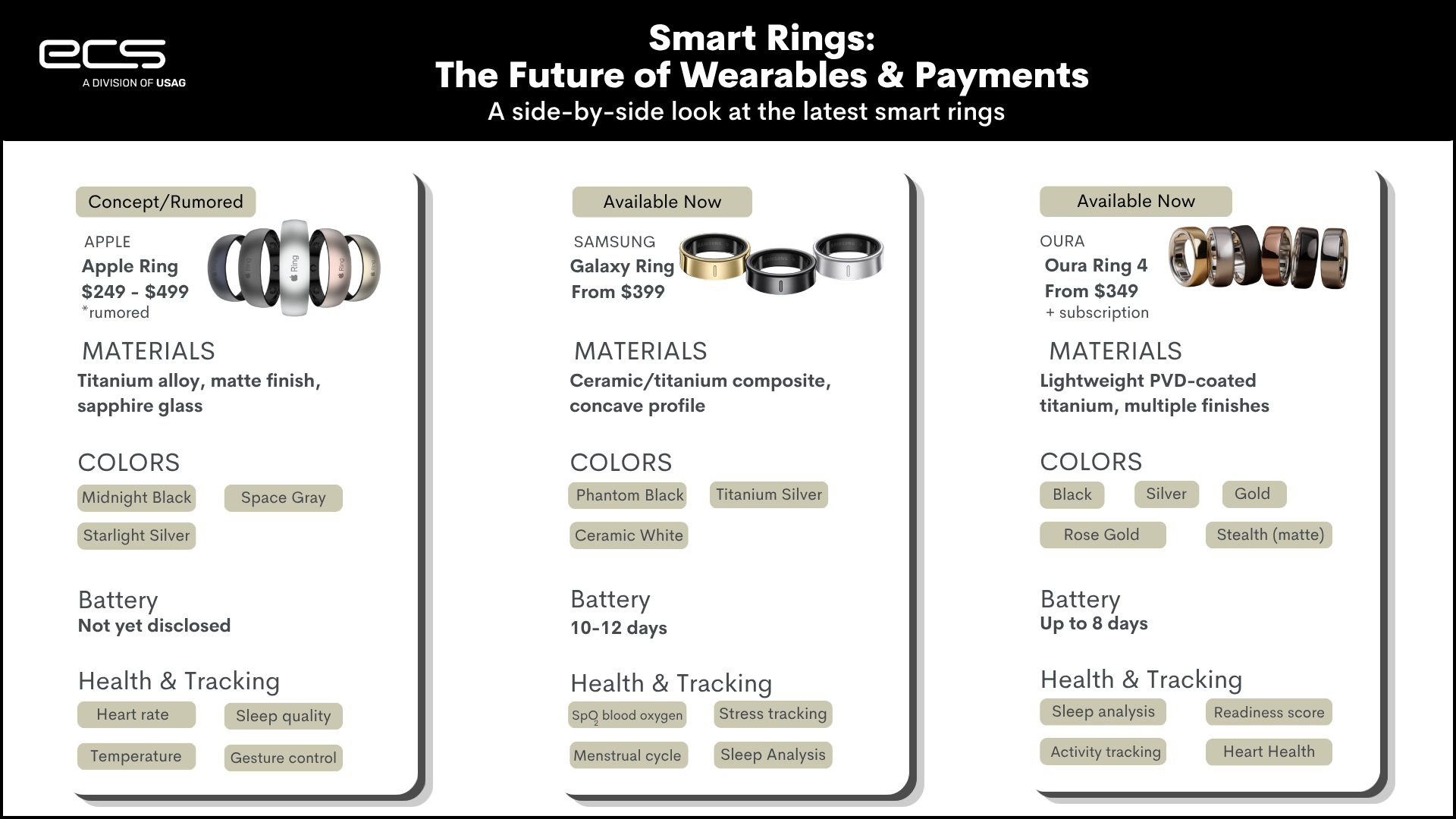
- Estimated Cost: Speculation places the Apple Ring in the $249-$499 range.
- Design and Materials: It is expected to follow Apple’s signature minimalist aesthetic, likely featuring a lightweight titanium or ceramic build to ensure durability for daily tasks.
- The Payment Speculation: The real value for merchants lies in the potential for an integrated Secure Element chip tuned for Apple Pay. Analysts suggest it could utilize “Skin-to-Skin” gesture controls. This feature would allow users to authorize a transaction with a simple tap of their fingers.
- Health and Connectivity: Beyond payments, it is rumored to have the ability to track heart rate and sleep quality, like the leading competitors. It will sync all data directly to the Apple Health app.
The Wearable Payments Competition: Samsung and Beyond
Apple is not the only giant in this space. The Samsung Galaxy Ring has already established a firm foothold for Android users. Priced around $399, the Galaxy Ring offers a titanium build and approximately seven days of battery life. Currently, Samsung has focused this device on health, but with Samsung Wallet already being a powerhouse, the infrastructure for a “Galaxy Ring Pay” update is highly requested. However, it is not yet in place.
Other players like Oura and RingConn are also refining their offerings. The Oura Ring 4, with 5-8 days of battery life, starting at $349, remains a gold standard for health accuracy. Although it does not support payments today, Oura’s recent acquisition of digital identity firms suggests that “keyless” and “cardless” features are the next logical step. On the other end of the spectrum, the RingConn Gen 2 offers a subscription-free model for roughly $299. It provides a staggering 10 to 12 day battery life.

According to Forbes Advisor, the global contactless payment market is expected to reach over ten trillion dollars by 2027, driven largely by the convenience of these integrated wearable devices.
Preparing Your Business for the Wearable Payments Wave
For a business owner, these tap-to-pay wearables are the ultimate tool for reducing friction. When paying is as simple as a gesture, the “pain of paying” is reduced. If a customer is out for a jog without their phone or wallet, they can still stop in your shop for a bottle of water. This is because their payment method is on their finger. This “always-ready” state of the consumer is something every business owner should be prepared to facilitate.
Data from J.P. Morgan indicates that businesses that implement contactless systems often see an increase in average ticket sizes because transactions are more fluid. By upgrading your systems now to support high-sensitivity NFC, you are future-proofing your business. This will protect you against the next wave of hardware.
How ECS Payments Supports the Wearable Payments Future
In a crowded marketplace, finding a partner that understands the technical shifts of 2026 and beyond is essential. This is where ECS Payments stands apart in the merchant services space. We do not just provide you with payment hardware, collect our transaction percentages, and call it a day. We view our relationship with merchants as a long-term partnership built on trust and technical excellence.
Our NFC-enabled POS systems are designed to be intuitive for both your staff and your customers. We ensure full compatibility with every major mobile wallet on the market, from Apple Pay to the specialized wearables of the future. The advantage of working with ECS Payments is our commitment to transparency and reliability. We prioritize our clients’ personal success by providing robust, future-ready solutions. These solutions actually make sense for their bottom lines.
Conclusion
The evolution of payments is moving toward a faster, more integrated world. Whether it is the upcoming Apple Ring or the refinement of existing health wearables, the goal is to make commerce easier for everyone involved. As a merchant, embracing these changes is one of the most effective ways to show your customers that you are ready for the future.
Reach out to the team at ECS Payments today to explore our suite of future-ready POS solutions and discover why so many businesses trust us to modernize and power their transactions.
