If your nonprofit is losing a significant percentage of every donation to opaque processing fees and clunky software, you are essentially asking your donors to subsidize your merchant service provider rather than your mission. It is a harsh reality that many executive directors face when they finally sit down to reconcile the year end books.
You work tirelessly to build trust with your community, only to have that momentum stalled by an outdated checkout page that looks like it belongs in 2005. Or maybe your monthly statements feel like they require a degree in forensic accounting to decipher. Managing the financial lifecycle of a gift requires a specialized approach, which is why understanding the nuances of nonprofit payment processing is the difference between a stagnant donor base and a thriving, sustainable organization.

What Is Nonprofit Payment Processing?
At its core, nonprofit payment processing is the specialized system that allows a 501(c)(3) or other charitable organization to accept financial contributions through various channels. While it shares the same basic infrastructure as retail processing, the intent and the data requirements are vastly different. When a customer buys a shirt, the transaction ends at the receipt. When a donor gives fifty dollars to a local food bank, that transaction is just the beginning of a lifelong relationship.
This process differs from standard business processing because it must account for tax deductibility, fund designation, and the emotional nature of the transaction. Standard processors often treat every swipe the same, but for a nonprofit, donation payment processing must be able to categorize a payment as a “General Fund” gift versus a “Building Campaign” gift. This is vital for legal compliance and donor satisfaction. A nonprofit payment management strategy ensures that the technology fades into the background, allowing the spirit of generosity to take center stage.
How Nonprofit Payment Management Works
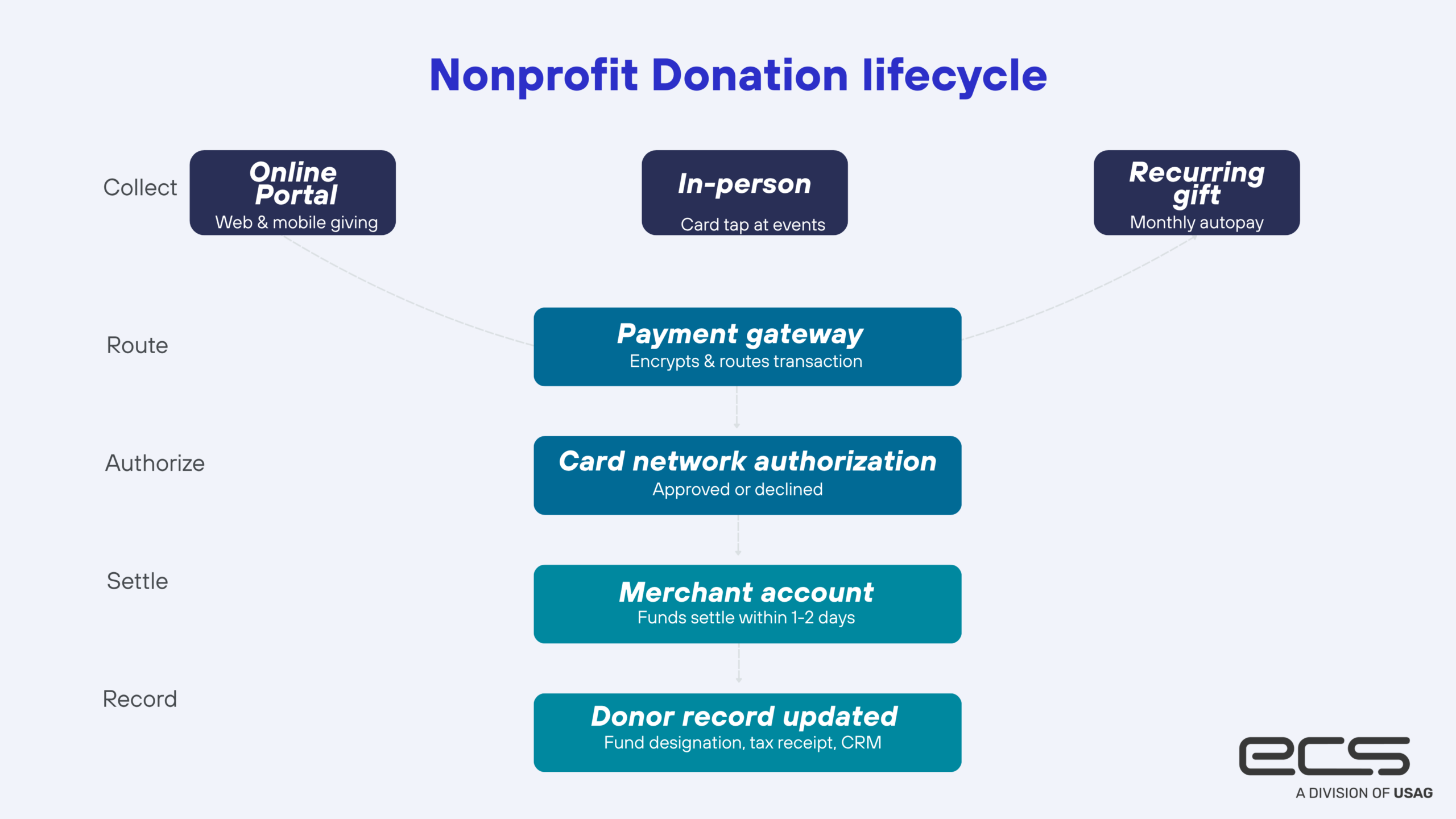
The journey of a donation starts long before the money hits your bank account. It begins with the collection phase, where you must meet donors where they are. When considering how nonprofits accept payments, you must realize it involves juggling online giving portals, in person “dip or tap” stations at gala events, and the increasingly popular recurring monthly gift. Each of these channels must funnel into a centralized system to prevent data silos that make your treasurer’s life miserable.
Once a donor submits their information, the payment processing and settlement phase begins. The funds move through a gateway, then the card networks authorize or decline, and if approved, land in your merchant account a day or so later. However, the work is not done there. True management includes the tracking and reporting of these donations.
You need to know not just that you received a thousand dollars, but that it came from ten different people with ten different mailing addresses for their tax receipts. Integrating these payments with your donation tracking and payment systems ensures that your development team has a real time view of who is supporting the cause without manual data entry.
How to Choose the Right Payment Solution for Your Nonprofit
Selecting the best payment solutions for nonprofits should never be a snap decision driven by a flashy advertisement or a pushy sales call. Because your processing platform sits at the intersection of your donor’s generosity and your organization’s bank account, there are several mechanical and strategic factors you must weigh before committing to a long term partnership.
Seamless Software Integration
The next major hurdle is how well the system plays with others. Your payment processing for nonprofits solution must integrate with your existing CRM or donor management software rather than existing as a digital island. When your systems communicate effectively, data flows automatically from the transaction to the donor profile. Your payment solution should be the missing puzzle piece that fits into your current workflow, not a technical wrecking ball that requires you to rebuild your entire administrative process from scratch.
Payment Flexibility and Mobile Optimization
When vetting nonprofit online payment systems, you should prioritize flexibility in how you receive funds. A truly robust system should offer multiple payment options, including standard credit cards, digital wallets like Apple Pay or Google Pay, and ACH bank transfers.
According to research from Double the Donation, the number of transactions completed through mobile devices has increased by 50% in recent years. This trend is clearly driven by the sheer ease of digital giving. If your processor makes it difficult for a donor to use their preferred mobile method, you are quite literally leaving money on the table.
Recurring Payment Capabilities
Recurring donation capabilities are another non-negotiable feature for any modern organization. These “set it and forget it” gifts provide the predictable, monthly cash flow that allows a nonprofit to plan for future programs with confidence. Beyond the transaction itself, look for tools that allow you to export clean, categorized data. This ensures that every recurring gift is properly attributed and easy to track over the lifetime of the donor’s relationship with your cause.
Transparent Pricing Structures
Many processors hide their true costs behind easy to calculate, but very expensive flat rates or tiered pricing models that look attractive on the surface but end up costing a fortune in “non-qualified” fees and hidden surcharges. You need a partner who offers a clear, honest breakdown of every penny spent. Understanding exactly what you are paying for allows you to keep your administrative costs low and your program funding high.
Scalability for Future Growth
Additionally, you must look for inherent scalability within the platform. A solution that works perfectly when you are raising ten thousand dollars a year might buckle under the pressure as you move toward six or seven figures. Your nonprofit payment management system should be able to handle sudden spikes in volume, such as during a capital campaign or a viral social media movement, without lagging or technical failure.
Security and Human Support
Reliability and professional support are the final pillars of a trustworthy system. When a donation form goes down on a high stakes day like Giving Tuesday, you cannot afford to wait forty eight hours for an email response; you need a knowledgeable human being on the phone immediately.
Finally, ensure the provider maintains the highest level of PCI compliance. This is the only way to protect the sensitive financial data of the people who trust you most and to safeguard your organization’s reputation from the fallout of a data breach.
The Real-World Benefits of Modern Payment Solutions
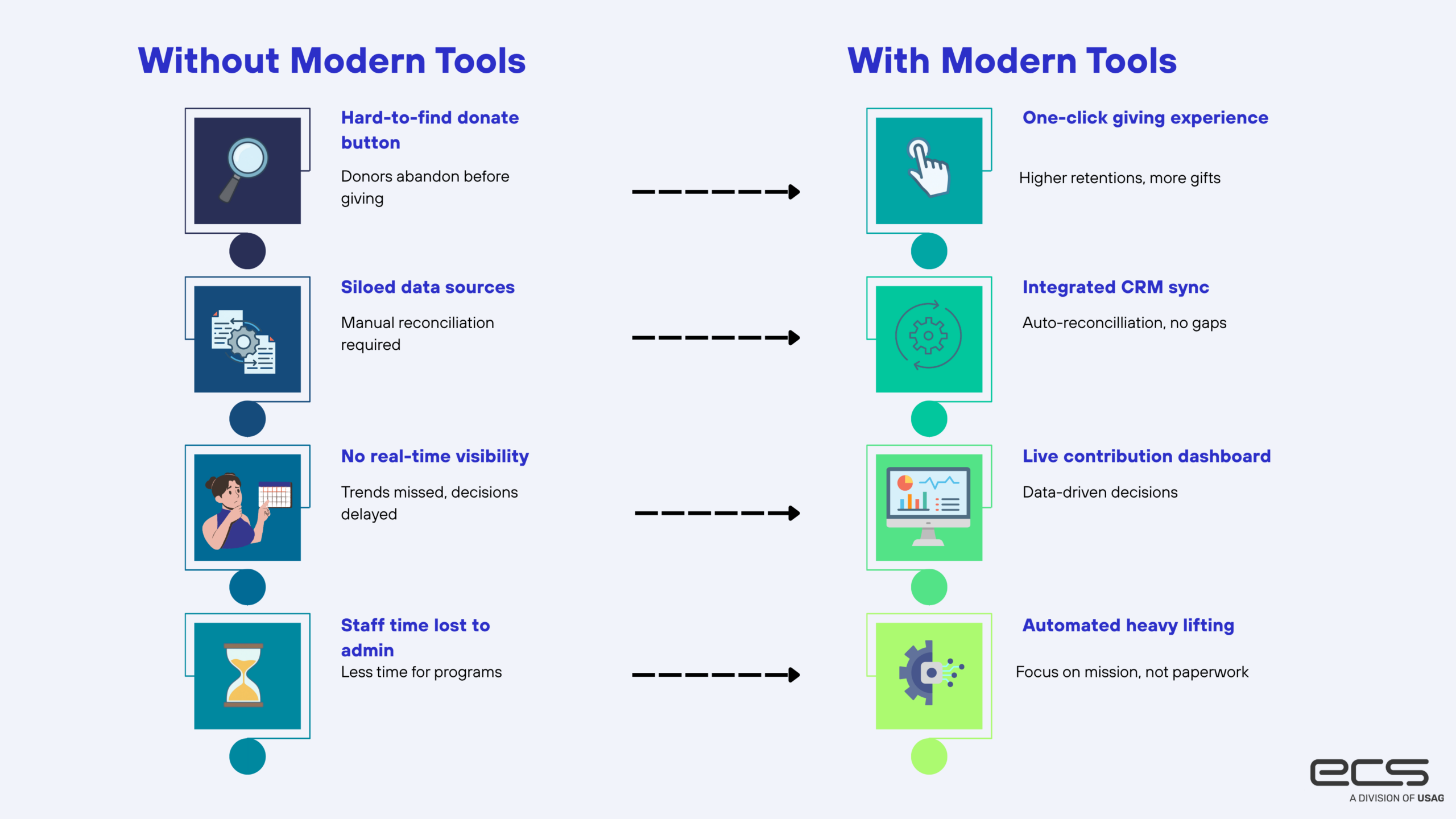
The switch to a modern, integrated payment solution offers benefits for both your donors and your administrative team. Most people want to support a good cause. But if they have to navigate a messy webpage to hunt down the “Give” button, more than likely, that moment of generosity is fleeting. Simplifying the collection process removes friction that leads to “abandoned cart” syndrome. Plain and simple, updated payment and webpages equal higher retention rates and more frequent contributions.
Internally, up-to-date nonprofit payment solutions provide much-needed visibility into your contributions. You can see trends as they happen, such as a spike in giving following a specific social media campaign, which allows for more informed, data-driven decision-making. If your administrative backend feels like it requires a computer science degree to navigate, your staff will likely dread pulling reports or reconciling the day’s gifts. You shouldn’t have to fight your own software to see the impact of your fundraising.
The administrative workload is drastically reduced when your system handles the heavy lifting of reconciliation. Instead of spending hours matching bank deposits to paper checks or disparate digital reports, your team can focus on community outreach and program development. The ultimate goal is a frictionless loop where your donors can give with a single click, and your team can see the results without a single headache.
Common Challenges Nonprofits Face
Many organizations struggle with managing recurring donations, particularly when credit cards expire or are replaced. Without an automated system to update card information or notify the donor, those consistent revenue streams dry up quick.
Another hurdle is tracking donor activity across multiple systems. If your donation tracking and payment systems don’t talk to your “gala” software, you might end up asking a major donor for a small gift because you don’t have the full picture of their generosity.
Handling multiple payment channels can also lead to a fragmented financial mess. If you have one provider for your website and another for your physical card readers, your reporting will always be a patchwork quilt of spreadsheets. This often stems from limited internal resources. Small to mid-sized nonprofits rarely have a dedicated IT or fintech department, making it difficult to troubleshoot technical glitches or negotiate better rates with aggressive sales agents.
How Payment Processing Can Support Cost Efficiency for Nonprofits
Efficiency saves time, of course. But, more importantly, it also protects your bottom line so more money reaches your actual programs. One of the most effective ways to reduce payment processing fees for nonprofits is by steering donors toward lower-cost payment methods, like ACH bank transfers, for larger gifts. While a percentage-based fee on a $5,000 credit card donation is a significant hit, an ACH transfer often carries a low flat fee.
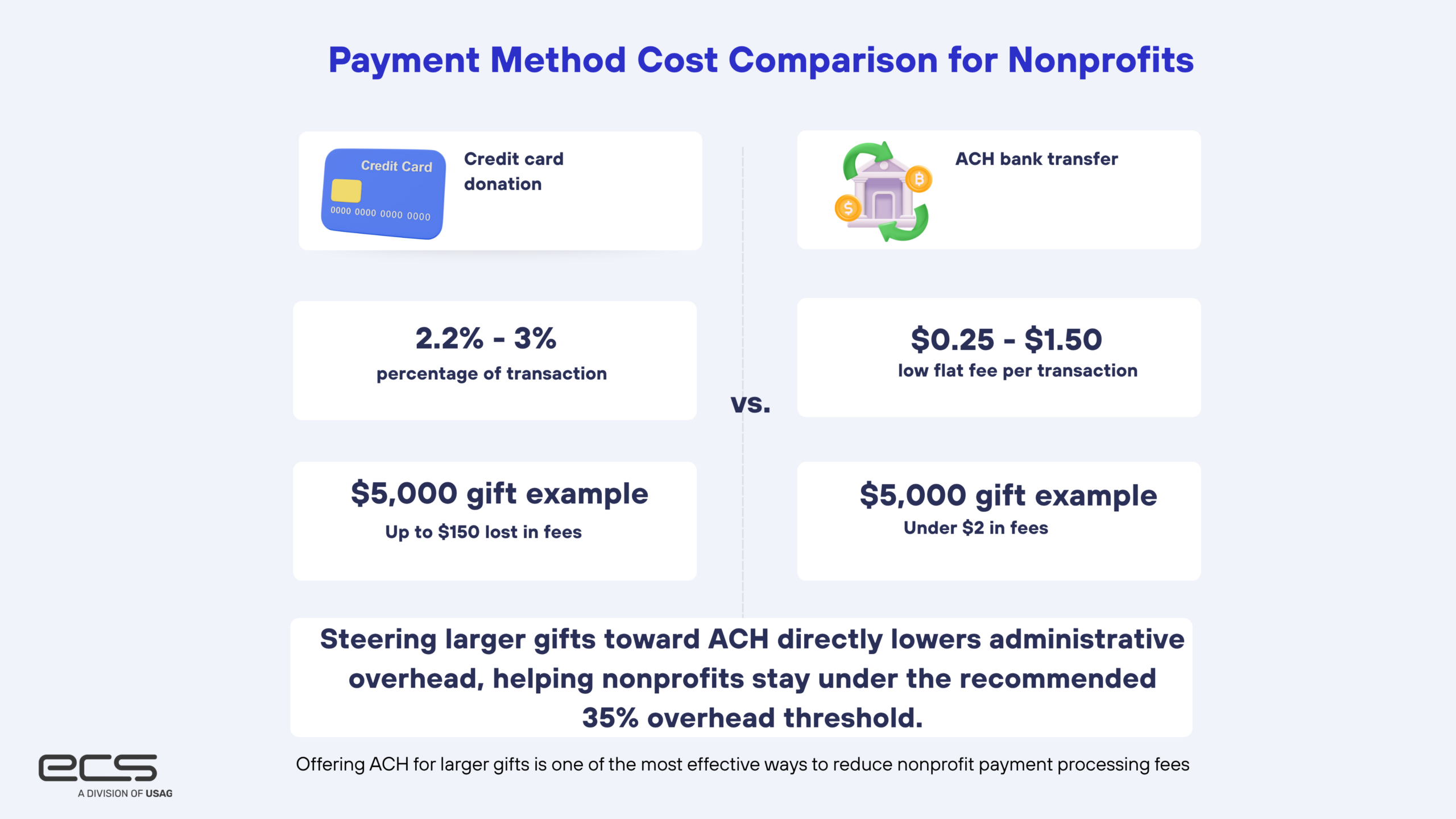
By reducing manual processing, you also eliminate the risk of human error, which can unfortunately lead to costly accounting nightmares. This is a critical move for your “overhead” health. According to the Charities Review Council, it is widely recommended that a nonprofit keeps its combined administrative and fundraising costs under 35% of its total budget to maintain high efficiency ratings. Streamlining your payment reconciliation can directly lower that administrative overhead and ensure that your organization shows donors that your judgment in the stewardship of their money is sound.
Best Practices for Managing Nonprofit Payments
To maximize your results, always offer flexible payment options. Some donors want the points on their credit card, while others prefer the simplicity of a bank draft. Providing these choices shows that you value their convenience. You should also make a concerted effort to automate recurring donations. Prompting a one time donor to “make this a monthly gift” at the point of checkout is one of the most effective ways to build a sustainable donor base using modern nonprofit payment solutions.
Transparency is your greatest asset. Maintain clear reporting so you can show donors exactly where their money is going if they ask. This level of accountability builds deep trust. Lastly, never cut corners on security. Ensure that you are using secure tokens to handle donor data so that sensitive information never actually touches your local servers. This protects both your donors and your organization’s reputation.
Nonprofit Payment Processing vs Traditional Payment Systems
Traditional payment systems are built for the “swipe and go” world of retail. They are designed for speed and volume and often overlook the unique needs of a charitable organization. In a retail setting, the customer is the focus of the transaction. In a nonprofit setting, the donor is the focus of the relationship. Specialized nonprofit payment processing providers understand that the transaction is a touchpoint in a much larger journey.
The requirements for nonprofits are unique. You need the ability to handle “cover the fee” options where donors can opt to pay the processing costs themselves. According to research, a significant percentage–33% according to some sources, and up to 65% from other sources–of donors are willing to cover these fees if simply asked at the point of donation. Traditional systems rarely offer this feature natively. Specialized solutions matter because they align with the specific goals of the social sector, prioritizing long term retention over short term transaction volume.
Why ECS Payments Is the Strategic Choice for Merchants
When it comes to selecting a partner for payment processing for nonprofits, many organizations find themselves stuck with large, faceless aggregators that offer “one size fits all” flat rates. At first glance, a flat 2.9% or 3.5% feels simple. However, for a high-volume nonprofit, that simplicity is incredibly expensive. This is often where organizations lose the most money because they are paying a massive premium for the convenience of not having to look at their merchant statement.
At ECS Payments, we believe in a more surgical and transparent approach. Our pricing model is built on an Interchange Plus structure that eliminates the guesswork. Specifically, we offer a rate of Interchange + 20 basis points (0.2%) + a $25 statement fee.
Even if you move away from flat-rate aggregators toward a more traditional processor, you still have to be careful. We often see competitors offer a “discount rate” that looks similar to our 0.2% markup, but they bury their real profit in what we call “junk fees.” For example, we recently reviewed a merchant statement where a nonprofit was being charged a $69.95 monthly fee for PCI non-compliance, plus an additional $29.95 for a vague “security bundle.” That is nearly $100 a month in extra costs before a single donation is even processed.
At ECS, we approach security differently. While we do have a $15 fee for PCI non-compliance, we waive it for the first three months to give you time to get settled. More importantly, that fee is easily removed entirely once you complete your due diligence to maintain compliance. We would rather you be secure than pay us a penalty.
Doing the Math: A Real-World Comparison
Let’s look at how these two structures play out for a nonprofit processing $50,000 a month in online donations. For this example, we will use the current 2025–2026 Interchange rates for a Visa Charity (MCC 8398), which sits at 1.35% + $0.05.
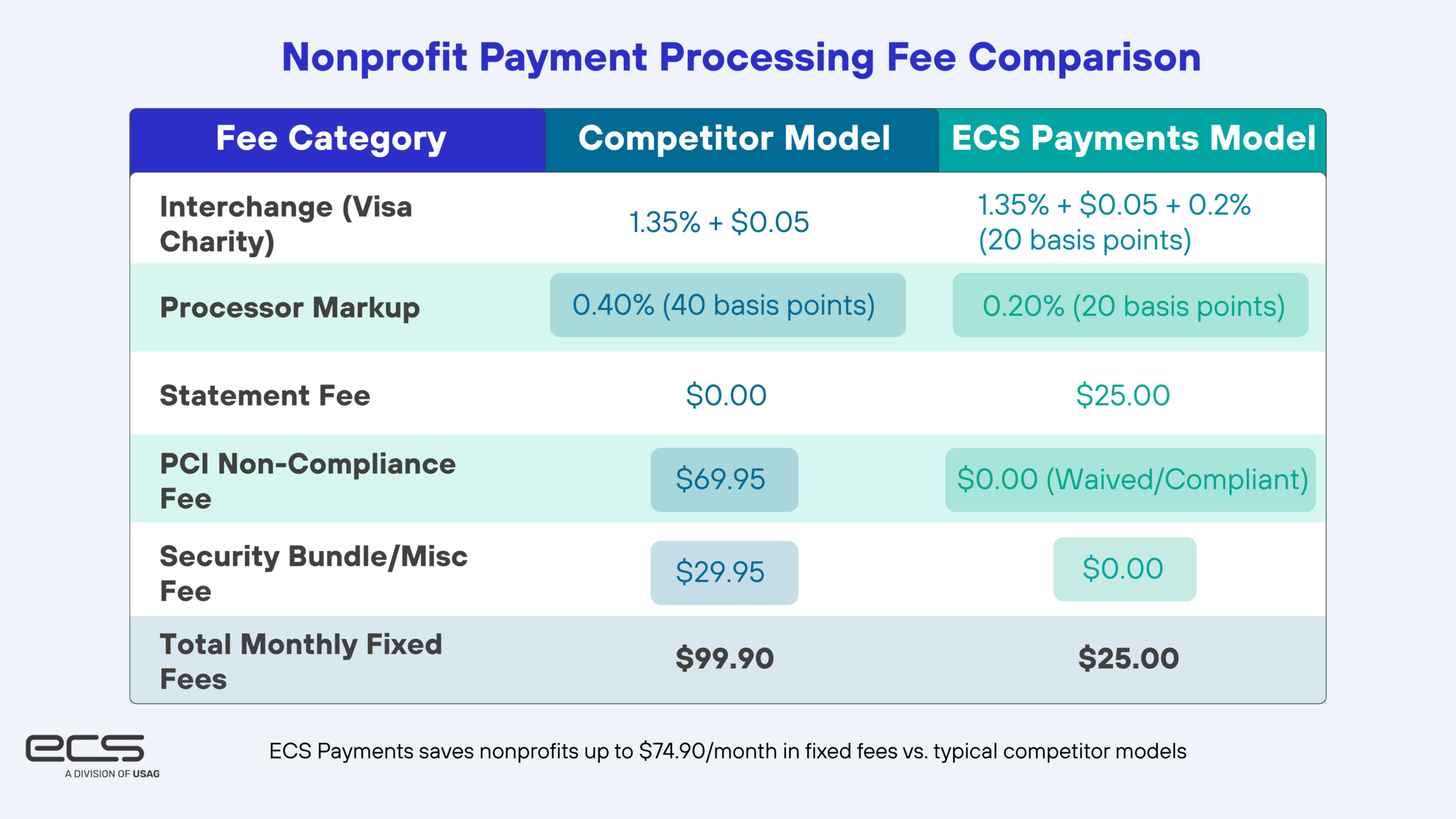
In this scenario, the nonprofit is essentially paying a “hidden tax” of nearly $75 every month, despite the competitor “waiving” the statement fee. Over a year, that is nearly $900 that could have gone toward your programs, staff, or community outreach.
If you look at your current merchant statement and see fees for “Security Bundles,” “Account Maintenance,” or high “Non-Compliance” penalties, it is an objective sign that your provider is prioritizing their margins over your mission.
Now, to make this even more concrete, we will assume an average donation size of $100, which equals 500 transactions per month. Now let’s calculate the actual cost combined.
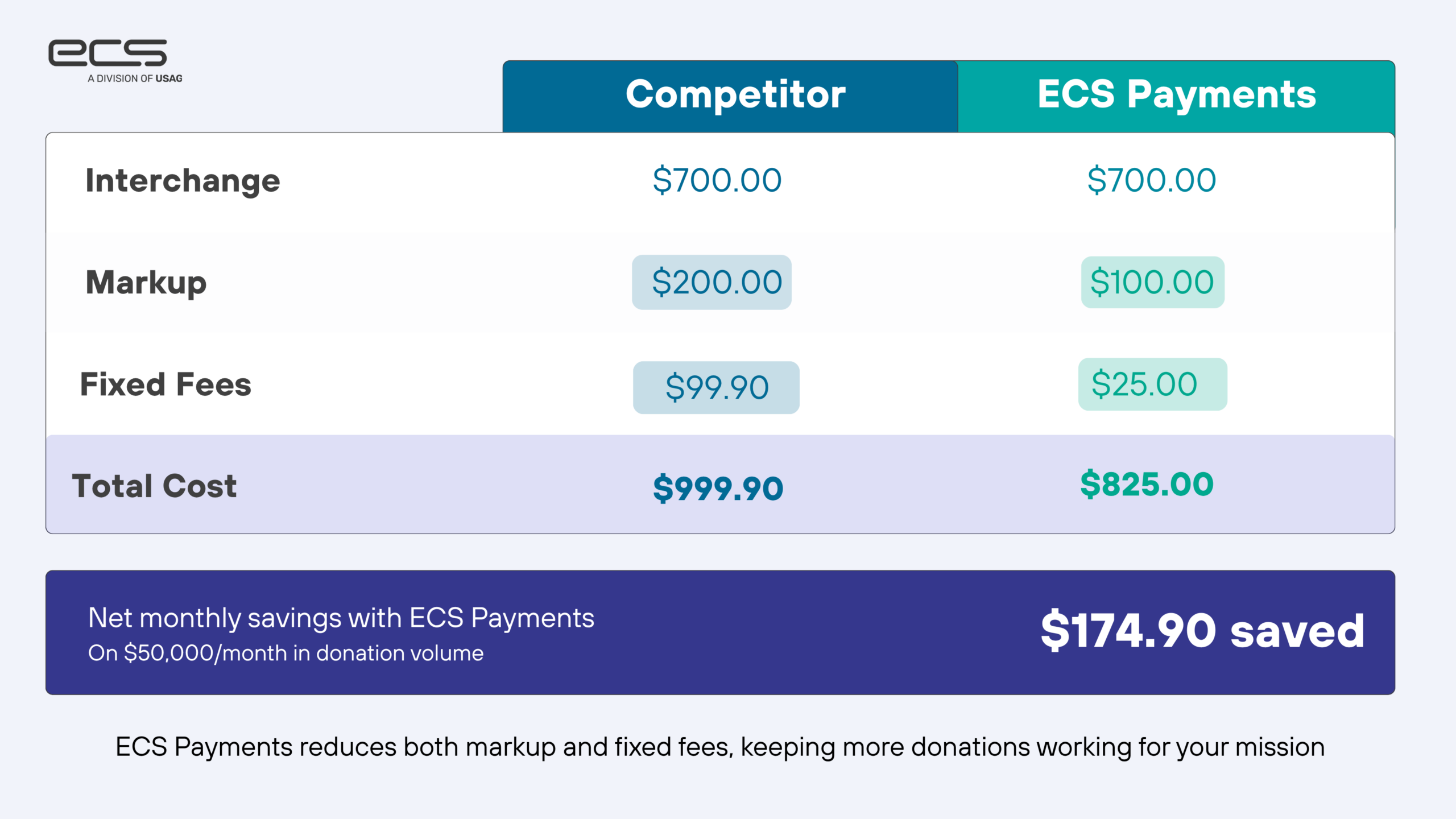
1. Interchange Cost (same for both)
- Percentage: 1.35% of $50,000 = $675.00
- Per transaction: $0.05 × 500 = $25.00
- Total interchange: $700.00
2. Processor Markup
Competitor 40 basis points (0.40%)
- 0.40% of $50,000 = $200.00
ECS Payments 20 basis points (0.20%)
- 0.20% of $50,000 = $100.00
3. Fixed Monthly Fees
- Competitor: $99.90
- ECS Payments: $25.00
Total Monthly Cost Comparison
Net Impact
With ECS Payments, you see a monthly savings of $174.90 which adds up to a savings of $2,098.80 per year. The hidden fees in our competitor’s model adds complexity and compounds cost in two ways:
- Higher markup on every single donation with inflated basis points
- Layered fixed fees such as non-compliance penalties, and unnecessary bundled services that quietly add up every month
That combination is what drives the gap past $2,000 annually in this scenario.
For a nonprofit, that clarity directly determines how much of each donation actually reaches your mission. When you reduce basis points and eliminate unnecessary fees, you are protecting donor intent and reclaiming capital that should never have left your organization in the first place.
Next Steps
A nonprofit’s health is dependent on the efficiency of its financial systems. Efficient nonprofit payment processing is a fundamental pillar of nonprofit growth. When you remove the barriers to giving and the hidden costs of processing, you create a frictionless environment where generosity can flourish. High quality nonprofit online payment systems provide the data, security, and savings necessary to support long term success and community impact.
Now is the time to take a hard look at your current nonprofit payment management and donation workflows. Pull your last three months of merchant statements and calculate your effective rate. If the numbers don’t align with a transparent, cost effective model, you are essentially leaving your mission’s money on the table. Consider a modern payment strategy as a core component of your organization’s broader strategic plan to help reduce payment processing fees for nonprofits.
