Should businesses consider licensing loan management software or building our own in-house solution? The answer to this question will depend on several factors, including the size of your business and the types of financial products you provide.
Actually, this question is similar to others you might ask, such as: should we build our own CRM or license a Salesforce product? Should we build our own accounting suite or use Quickbooks?
Licensing software products makes more sense for most small to midsize businesses and even some larger businesses. But don’t take our word for it…let’s take a deeper look.

The True Cost of Developing Software Applications
The first consideration is the cost of building a software solution. You might think this part won’t cost so much. After all, you could use geo-arbitrage to hire a programmer in the Philippines or even use ChatGTP to write some code.
That will work if you’re building an alternate version of Candy Crush (dim sum crush, anyone?). But beyond shattering a panoply of colored sweets, these low-cost solutions cannot provide a software product on par with what a scalable financial services company can provide.
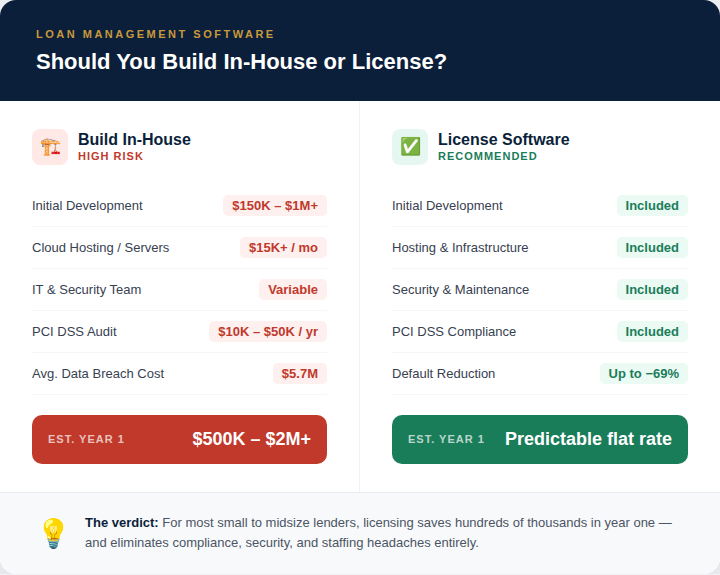
Simple Applications can cost $40,000 to $60,000 on average to develop. More complex ones can cost $60,000 to $150,000. And complicated applications can cost $150,000 to several million dollars.
These costs are influenced by several inputs (as programmers might say). How complex is the design? The database? How many different screens or windows are there? Are there security protocols? How tight are the quality assurance parameters? What functions and features are there? How many third-party integrations does it need?
The founders of Uber put $400,000 into their initial development (and lots of snake oil sales pitches beyond that). The founders of Instagram needed $500,000 to get started and another $57 million after that. The fintech app Robinhood took two years and $16 million to develop before inspiring a generation of subreddit memes using scenes from The Wolf of Wall Street.
Angel Investors…Or A Deal With the Devil?
In conclusion, it would seem that quality application development is out of the question unless you can get investors. Loan management software may not need to be as complex as apps that allow investors to invest in fractional shares of GameStop. But it will be much more complex than apps allowing customers to explode lemons and gumdrops.
So that means investors. Will you dive into the Shark Tank and secure funding with a memorable televised monologue? Never say never. You could also use a grassroots funding site like MicroVentures to gain some traction.
But the serious money has to come from a smaller group of institutional investors. These are the folks laying out the big bucks. The problem is that they may want something in return. Obviously, they want a return on their investment.
However, they may also want to exert control over company policy and may withhold funding if they don’t get their way. A Harvard Business Review study found that most of the founders of 212 startups from the 90s and early 2000s surrendered control of their company before it even went public, resulting in a complex the author dubbed “The Founder’s Dilemma.”
This is a serious consideration for any business owner or board of directors. Will the cost of developing mortgage management software or micro loan management software (to cite two examples) cost us control over our brainchild?
Where Is Your Business In the Growth Cycle?
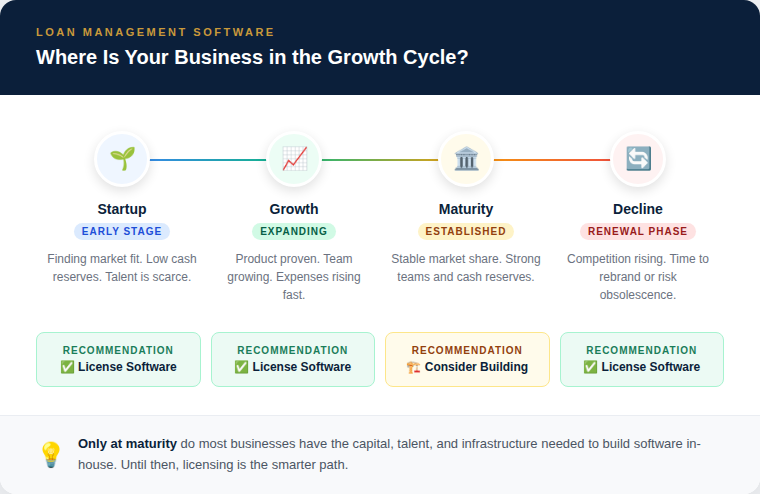
The size of your business is another related consideration. There are different paradigms for examining business growth, but let’s use the four-part theory for illustration. Businesses go through startup, growth, maturity, and decline. Whatever phase your business sits in will help determine if loan servicing software is something to build out or subscribe to.
Startups
Startups are just getting…well, started. They are finding their place in the market and determining if there is viability. Cash reserves are low. Holding on to human talent might be a struggle. At this point, the jury is out on whether or not the business will survive long term.
Growth
In the growth phase, a startup has successfully proven there is a need for its product, and it can hold its own among competitors. The human talent pool needs to expand. Operating expenses increase. Cash reserves might still be limited.
Maturity
Then there is maturity. At this point, the company has an established market share. Policies, procedures, and teams are in place to ensure the company runs smoothly. The owners and founders no longer need to be hands-on. They can pursue other projects, like buying up massive amounts of farmland or developing oddly shaped rockets.
Decline
And finally, the winter of our discontent: decline. Competitors have entered the market and begun to lap up the proverbial moat around the castle. Thankfully, at this point, the company has brand recognition, cash reserves (ideally), and lots of talent. They can revamp, remodel, and rebrand to enter the renewal phase. Otherwise, they go the way of Pets.com (put to sleep).
Right now, it’s safe to say that financial institutions like Wells Fargo, Bank of America, Chase, and Citibank are in the maturity phase of life. Then, regional banks like Truist and Ally are aggressively pursuing mergers to graduate the growth phase.
If your business is still in the startup phase, you do not have the type of in-house human talent to develop and service applications. You do not have the cash reserves to build your own. Your choices are to either secure rounds of funding, get a substantial loan, or learn lots and lots of computer programming.
Do You Sell Your Own Loans or Repackage Them?
Another consideration is what type of financial products you sell. If you are repackaging loans like mortgages, SBA loans, or VA loans, you probably have your own set of dashboards to look at. You cannot pass these on to your borrowers.
That means some type of integration to bridge the gap between the internal and external dashboards you allow customers to access. Supporting the bridge between these two systems involves many compliance and regulatory issues.
What about businesses that sell their own loans? Suppose you are a small bank accepting consumer deposits and loaning this money to local businesses. Your lending management system must integrate with the software you use for managing accounts. Otherwise, your bankers will be doing a lot of paperwork, shuffling numbers between two systems.
Either way (whether you sell repackaged or own loans), your lending management software must integrate with other systems. Developing these integrations adds to the expense of building your own in-house software.
Other Hidden Costs in Software Development
There are other hidden costs to a loan management system (or any software, for that matter). One is integrating your loan servicing systems with other digital platforms, as mentioned above. The more integrations, the more it will cost you.
You will also have to store your loan management solution somewhere. This means you will need your own data center, or you will have to use “the cloud.” The cloud means using a remote data center like those provided by Amazon. Either of these options is going to cost you.
The cost of data storage can be immense. If you have your own servers, you will need a physical place to put them, which will have its own expenses. Data centers have huge utility bills, and commercial-sized centers have an annual operation cost (on average) of $10+ million.
If you store data in the cloud, you’ll still need to pay to “rent” that space. This can cost as much as $3,000 per terabyte of data. Parking the infrastructure needed to power a small business can cost as much as $15,000 per month. As your customer base grows, you’ll have more data to store and more to pay.
Which brings us to other hidden expenses. You will need an IT department to exercise constant vigilance in warding off data breaches. The IT department will also have to service routine maintenance issues because they will inevitably happen.
The IT department will have its own expenses that vary with the size and scope of your software. Another hidden (potential) cost is the risk of a data breach. The average cost of a data breach in the financial sector is $5.7 million. Of course, you can purchase insurance to defray the fallout of such an event, but that will be another expense.
Other Customer-Centric Hidden Expenses in the Loan Management Process
But wait…there’s more. You will need technical support if your lending systems have any kind of customer interface. Studies show that customers do not like outsourcing, so if you want that coveted five-star status, you’ll need stateside help. This is another set of expenses: salaries, insurance, office space, or, at the very least, a separate set of software for inbound calls.
We’re not done yet. Another hidden customer expense is marketing your software. If your loan software facilitates a smoother lending process from the customer end, that is something you will want to advertise. Competitors like Rocket Mortgage and every single credit card company tout their painless online applications. You will need to advertise this as well.
Now you have a marketing budget. Print ads, social media ads, mailed ads…they all have their pros and cons. You’ll need a marketing team and a marketing budget. Banks, lenders, credit unions, and investment first all have marketing departments.
Increasingly, banks and lenders are not relying on interest rates alone to attract customers. Around 91% of consumers consider digital banking important when selecting a bank or lender. That’s why banks and lenders today offer mobile apps that perform complex tasks like analyzing spending or calculating loan durations based on payments.
Please Don’t Call…Just Check The App
Indeed, you don’t need to offer all these bells and whistles on the consumer interface. However, if you don’t, there’s a decent chance you will lose some market share to competitors that do. Today’s borrowers like to log into apps and see how big their balances are. They like to have visual, tangible representations of their finances.
This type of customer interface can also save you time and money regarding debt collection. Customers who can access the information will be less likely to call and ask about it. Software applications can also apply process automation to debt collection.
Customers can be prompted about monthly payments with texted and emailed reminders. If you have your own proprietary app (or an app is part of the software solution you license), the app can send reminders about upcoming payments.
As collecting payments is one of the biggest headaches in lending, this type of process automation is indispensable. Loan management software can also render some flexibility regarding repayment, such as allowing customers to switch their payment dates. One study showed that such flexibility, combined with automated loan reminders, reduced defaults by 69%.
Cost Benefit Analysis
As you can see, there are costs to developing software, but features that reduce losses (e.g., automated reminders to reduce defaults) and even increase profit (e.g., the marketing appeal of its functionality). Whether or not you should build your own in-house software versus licensing it from a third party depends on a cost-benefit analysis.
For most small to midsize businesses, while the benefits are substantial, the costs of building and maintaining said software (e.g., the tech support, the IT support, and the customer-facing support) outweigh the benefits.
You can also outsource these concerns (IT, tech support, marketing) while keeping the software in-house. However, the disconnect between your own internal product and third-party contractors will make the answer to this question of cost six of one and half a dozen of the other.
And yet, the benefits of loan software should still be brought to fruition. And they can be if you just license the software from a third-party vendor.

One Last Cost To Discuss
One final cost to discuss is the cost of storing customer data. We have already touched upon this regarding data storage and vaguely hinted at security breaches. But beyond preventing outright data theft (a very lucrative theft in your industry), there is the cost of keeping customer data on file…particularly payment data.
Functional lending software will allow customers to automate payments or at least log into a portal to make recurring payments from a card or checking account on file. COD transactions (card on file) must follow specific protocols outlined by card networks like Visa and Mastercard.
These protocols are called Payment Card Industry Data Security Standards or PCI DSS. A PCI DSS annual audit alone can cost tens of thousands of dollars. For most businesses, collecting and storing borrower repayment data in alignment with PCI DSS is cost-prohibitive.
Again, another hidden cost. Add it to the development, maintenance, IT, marketing, storage, and tech support costs. Thankfully, all these costs can be passed on to a third party if you subscribe to or license their software.
And In Conclusion…
Licensing loan software is a clear win for almost every small to midsize lender. You may have concerns about what this loan software will look like and if it can fit in with the needs of your specific market (B2C, B2B, personal loans, car loans, mortgages, credit cards).
Fear not. Software companies are fully aware of their customer needs for nuanced solutions. They have their own large engineering and “architectural” teams ready to tailor specific solutions to the needs of your business.
When you work with a software company providing a product as large, nuanced, and complicated as financial software, you will get the white glove treatment. You will have a dedicated account manager who heads a team of professionals dedicated to customer success (that means you and your business).
Many small to midsize businesses in most verticals now outsource their software. That’s why companies like Oracle, Salesforce, and Amazon are huge. However, working with one of these larger companies may not be good for small to midsize businesses.
These large software behemoths are well-poised to set up contracts with other large companies. However, smaller and midsize businesses may get funneled into cookie-cutter products that don’t quite fit.
It’s important to find a software company that can respond to the needs of your business in a more personalized, attentive manner. And if you’re still wondering about creating your own in-house solution, this is best explored when your company is finally in maturity. Until then, we would love to hear from you and learn about the financial products you offer.
Frequently Asked Questions About Licensing Vs. Building Loan Management Software
What should I consider when deciding whether to license or build in-house loan management software?
The best decision will depend on factors such as your business size and product offerings, the state of your growth, the cost of development, integration with your current systems, and the potential loss of control over independent company policies with external funding.
What are the cost factors of building in-house loan management software?
Developing loan management software involves costs influenced by factors such as the complexity of the design and database, quality assurance parameters, security protocols, data storage costs, and IT and technical support. However, licensing software often proves more cost-effective, especially for small to midsize businesses.
What are the benefits of licensing loan management software?
Licensing loan management software from a third-party vendor provides lenders with reputable software companies that offer dedicated account managers and professional teams focused on customer success. Third-party companies have a better overall knowledge of the software, ensuring a personalized approach to meet the unique requirements of various businesses.
Does the business growth phase influence the proper decision to build or license loan management software?
Yes. It should. Whether a business is in startup, growth, maturity, or decline, plays a crucial role in determining the feasibility of building or licensing loan management software. Startups may lack the resources they need for in-house development, whereas mature and successful businesses might have an established market share and team to make building a more practical choice.
